The Ad Script Formula We Use When a Founder Says 'I Don't Know What to Say'

The most common thing a founder says to me when we start talking creative isn't "my ads don't work". It's quieter than that. It's "I don't know what to say." They've got the product, they believe in it, and then the cursor blinks in an empty script doc and nothing comes.
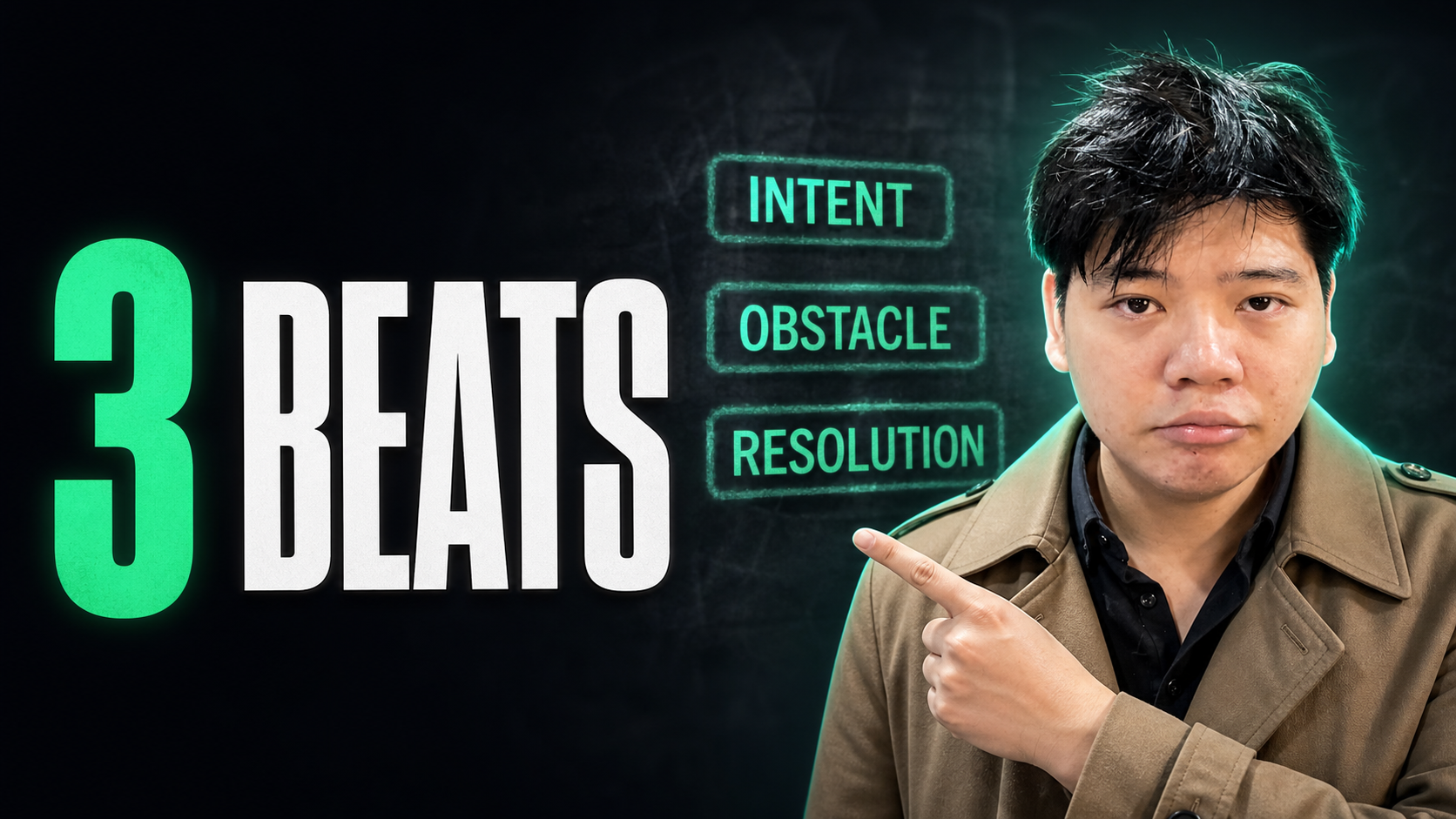
So this is the structure I hand them. It's not the only way to write an ad, but it's the one I reach for when someone's stuck, because it turns a blank page into four boxes to fill in. Intent, obstacle, resolution, and then the proof and the ask stacked on top. Fill those in honestly and you have an ad. Let me walk through it.
Start with intent: name what they're actually trying to do
Every good ad starts by naming the thing the customer is already trying to achieve. Not your product. Their goal. The state they want to be in.
This is the part people skip, and it's the most important one. If someone's scrolling and you open by describing your product's features, you've lost them, because they don't care about your product yet. They care about the thing they're trying to do. So you lead with that. "You want to sleep through the night." "You want your skin to stop flaring up." "You want to get out the door in the morning without the chaos."
When you open on their intent, you've done the most valuable thing an ad can do in its first two seconds: you've made the stranger feel seen. They think, yes, that's me, that's the thing I want. Now they'll give you another few seconds. That's all the opening has to buy you.
Then the obstacle: name the thing standing in their way
Right after the intent, you name the obstacle. The reason they haven't already got what they want. And here's the key: the obstacle has to be something outside their control, or at least something that isn't their fault.
This matters more than it looks. If you frame the obstacle as a personal failing - you're lazy, you're undisciplined, you haven't tried hard enough - the customer gets defensive and clicks away. Nobody buys from the brand that just insulted them. But if you frame the obstacle as something external, something done to them, you're suddenly on their side against a common enemy.
So instead of "you can't stick to a routine", it's "every product out there is loaded with the one ingredient that keeps triggering the problem". Instead of "you're disorganised in the mornings", it's "none of the systems you've been sold were built for a household with three kids in it". Same situation, completely different feeling. One blames them, the other blames the broken thing in the world, and positions you as the one who noticed.
That's the emotional turn of the whole ad. You named what they want, then you named the unfair thing standing in the way, and now they're leaning in, because finally someone gets it.
Then the resolution: your product as the bridge
Only now do you bring in the product. And you bring it in specifically as the thing that removes the obstacle you just named. Not as a list of features. As the bridge between where they are and the intent you opened with.
The sequence is everything here. Because you named the obstacle first, the product now has a job to do, and every feature you mention is framed as how it beats that specific obstacle. "That's why we built it without the trigger ingredient." "That's why this system assumes the chaos instead of pretending it away." The feature isn't a feature anymore. It's the answer to the problem they're now bought into.
This is why founders who lead with the product struggle, and founders who lead with intent and obstacle don't. Same product, same features. But by the time you introduce it, the customer is primed to see it as the solution rather than just another thing being sold to them.
Stack proof on top, because they don't believe you yet
Here's the thing you have to be honest with yourself about: at this point the customer wants to believe you, but they don't, not really. They've heard a hundred brands make a hundred promises. So you have to back the claim, immediately, with proof.
Proof is anything that makes the promise feel true rather than asserted. The strongest version is showing it rather than saying it - the demonstration, the before and after, the thing actually working on camera. After that, other people's words: reviews, testimonials, the pile of five-star ratings, the user-generated clip of a real customer who isn't you. Numbers help too, the stat that quantifies the claim.
The rule I'd burn into your head is simple: every claim needs a piece of proof sitting right next to it. If you say it's gentler, show the test. If you say people love it, show the reviews. An unproven claim is just noise the customer scrolls past. A proven one is a reason to act. The proof is what converts the lean-in you've earned into actual belief.
Close with one clear ask
Then you ask. Once, clearly, for one thing.
This is where a lot of ads fall apart at the last hurdle. They've done the work, earned the attention, built the belief, and then they hedge the ending with three different suggestions. Go to the site, or check the bio, or maybe follow for more. Give someone three doors and they walk through none of them. The energy you built just leaks away.
So pick the single action you want and ask for only that. "Tap the button and try it." One call to action, stated plainly, with a reason to do it now. The whole ad has been building a small amount of momentum, and a single clear ask is what turns that momentum into a click. Anything more than one, and you've given them an excuse to defer the decision, which is the same as losing it.
Putting it together
So that's the spine. Open on their intent so they feel seen. Name the obstacle as something outside their control so you're on their side. Bring in the product as the bridge that beats that obstacle. Stack proof next to every claim so they actually believe it. Then ask once, clearly, for the one thing you want them to do.
The reason I love handing this over is that it works even when inspiration doesn't show up. You don't have to be a brilliant copywriter to fill in four honest boxes about your customer and your product. And nine times out of ten, the founder who told me they didn't know what to say discovers they knew their customer's intent and obstacle perfectly well all along - they just didn't have a structure to hang it on.
Try it on your worst-performing ad. Pull it up, and check: did it open on the customer's intent, or on your product? Did it name an obstacle that's the customer's fault, or the world's? My bet is the fix is sitting right there in the first two seconds. And if writing the angles is the part that keeps stalling you out, that's a lot of what we do for the brands we work with - turning a founder's messy, true understanding of their customer into scripts that actually follow this shape.


Recent Insights®



.webp)

Powered by © Pigeon Digital 2026. All rights reserved.
We acknowledge the Traditional Owners of the land on which we work, the Wurundjeri Woi Wurrung Cultural Heritage Aboriginal Corporation people of the Kulin Nation, and pay our respects to Elders past and present. We recognise their continuing connection to Country, culture and community.
.svg)