
What? So What? Now What? - The Daily Update Format Every Ad Agency Should Send (and Most Don't)

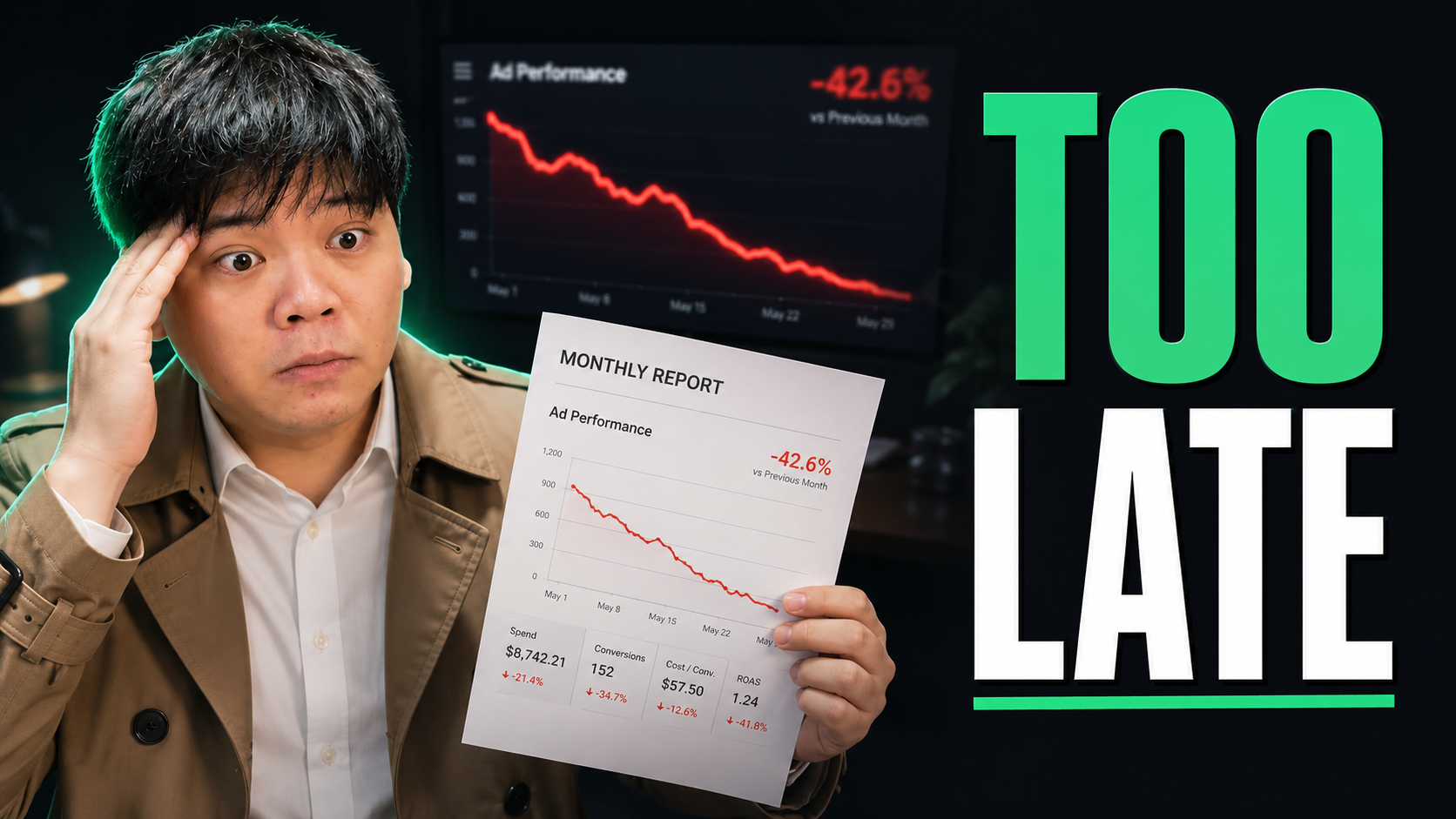
A homewares brand came to us last year after a quarter where the numbers had quietly fallen apart. Nice business, sharp founder, a previous agency that sent a clean report on the 1st of every month. The reports were genuinely tidy. Charts, a RAG status, a paragraph of commentary.
The problem was the timing. By the time the founder saw that March had missed, it was the 3rd of April and the month was already gone. Three weeks of the account drifting, and the first anyone said the word "behind" out loud was after it was too late to do anything about it.
That's the thing almost nobody flags when they talk about agency reporting. The danger isn't that you won't get a report. You'll get a lovely report. The danger is the gap between something going wrong and anyone acting on it.
I've started calling that the lag, and I think it's the single most useful thing to grade an agency on.
Reporting tells you what happened. Managing changes it.
Here's the distinction I'd burn into your brain before you hire anyone.
A report is a description of the past. It's accurate, it's often pretty, and it is completely powerless to change the result it's describing. By the time a monthly report lands, every decision that mattered has already been made or missed.
Managing is different. Managing means someone is watching the account closely enough to catch a miss in days, not weeks, and is on the hook to do something about it before the window closes.
Most agencies report. Very few manage. And the way you tell them apart is almost embarrassingly simple: can they tell you, every single day, three specific things?
What's happening. What it means. What they're doing about it.
If they can answer all three every day, they're managing the account. If they can only ever give you the first one, in a deck, once a month, they're reporting on it. Those are not the same service, even when they cost the same money.
The daily format, published
So rather than describe it, I'll just hand you the thing. This is the shape of the update our team sends on the accounts we run. We call it, internally, the daily map note - the idea being that we're on a journey together and every day we look at the map and check we're still heading the right way.
It has three sections, in this exact order, and the order matters.
What? Just the facts, no spin. Where contribution sits versus the plan for the month so far, in dollars and in percent. Where revenue, spend and blended ROAS are tracking. One brand we run might open with: "Contribution is ~A$11k behind the month-to-date plan, a gap of about 9%. Spend is bang on target, revenue is the thing trailing." Plain. Honest. No hiding the red.
So what? A short read of where that gap is actually coming from. Is it a volume problem or an efficiency problem? There are really only three kinds: you're not driving enough volume, you're not driving it efficiently, or both. In the example above, spend on plan but revenue behind tells you instantly it's efficiency, not volume. So the next layer: new-customer revenue is soft, returning revenue is fine, and the dip is concentrated in two scaled campaigns that lost efficiency over the weekend. Now you know where to look.
Now what? This is the part that matters most, and it should be the longest section in the message. Not "we'll keep an eye on it." The specific actions being taken today to close the gap. Pulling budget out of the two campaigns that faded. Pushing it into the three that are running ahead of efficiency. Briefing two fresh angles because the current ones are fatiguing. A direct question back to the founder where one's needed: "do you want to extend the promo a day to recover the volume, yes or no?"
That's the whole format. What, so what, now what. Every day, not every month.
Why the order is doing the heavy lifting
The sequence isn't decoration. It forces a particular kind of thinking and it makes hiding impossible.
You can't write a real "now what" without having done an honest "so what" first. And you can't fake a "so what" if the "what" is sitting right above it in black and white. By the time you've stated the gap in dollars, diagnosed whether it's volume or efficiency, and committed to a specific action, there's nowhere left for vagueness to live.
Compare that to how most updates read. "Performance was a little soft this week, we're optimising and expect things to pick up." That sentence has no "what" you can check, no "so what" you can argue with, and a "now what" that means nothing. It's the written form of a shrug.
The daily format kills the shrug. Somebody has to show up each morning, say exactly where they are against where they said they'd be, and tell you what they're doing about it. That's accountability you can actually see.
The "now what" is only as good as the plan behind it
There's a quieter reason this format works, and it's about what happens before the month even starts.
A good "now what" usually isn't invented in a panic. It's pulled from a back pocket. Before the month begins, you should already have contingencies sitting ready: the promo extension you can trigger if the first few days come in light, the last-chance creative built and waiting, the campaigns earmarked to scale if efficiency holds.
So when day three comes in behind, the "now what" isn't "let us think about it and get back to you." It's "we're pulling the extension we'd planned for exactly this, the creative's already with the buyer, it goes live this afternoon." Fast, because the move was anticipated, not improvised.
That's the difference between an agency reacting to your account and one that planned for the inevitability of things going slightly wrong. Every forecast is wrong somewhere. The good operators just assume that in advance and build the responses before they're needed.
How to actually use this
You don't need to take my word that this is better. You can test your current setup against it directly.
For the next week, ask your agency for those three things each day. Not a full report, not a dashboard login, just the three lines: what's happening, what it means, what you're doing about it.
Watch what comes back. If you get a specific gap in dollars, a clear volume-or-efficiency read, and a concrete action, you've got people managing your money. If you get "things look fine" or "we'll send the report Friday," you've learned something more valuable than any single month's ROAS.
And honestly, even if you never share it with an agency, run the three questions on yourself. Open the account, ask what's happening, what it means, what you're going to do today. The discipline alone will catch things weeks earlier than a monthly cadence ever could.
Because the gap that quietly kills accounts isn't usually a dramatic blow-up. It's three weeks of drift that nobody named out loud until the report landed and the month was already gone.
If you're not sure whether what you're getting each month is management or just a tidy description of the damage, that's worth knowing for certain. A Signal/Noise Audit walks your account and your current reporting side by side, and shows you plainly where the lag between something going wrong and someone fixing it is costing you. Sometimes the account's fine and the reporting's the leak. Either way, you'll stop guessing.


Recent Insights®



.webp)

Powered by © Pigeon Digital 2026. All rights reserved.
We acknowledge the Traditional Owners of the land on which we work, the Wurundjeri Woi Wurrung Cultural Heritage Aboriginal Corporation people of the Kulin Nation, and pay our respects to Elders past and present. We recognise their continuing connection to Country, culture and community.
.svg)