Reverse Prompting for Ad Ops: Why Your Over-Engineered AI Prompts Are Costing You Money

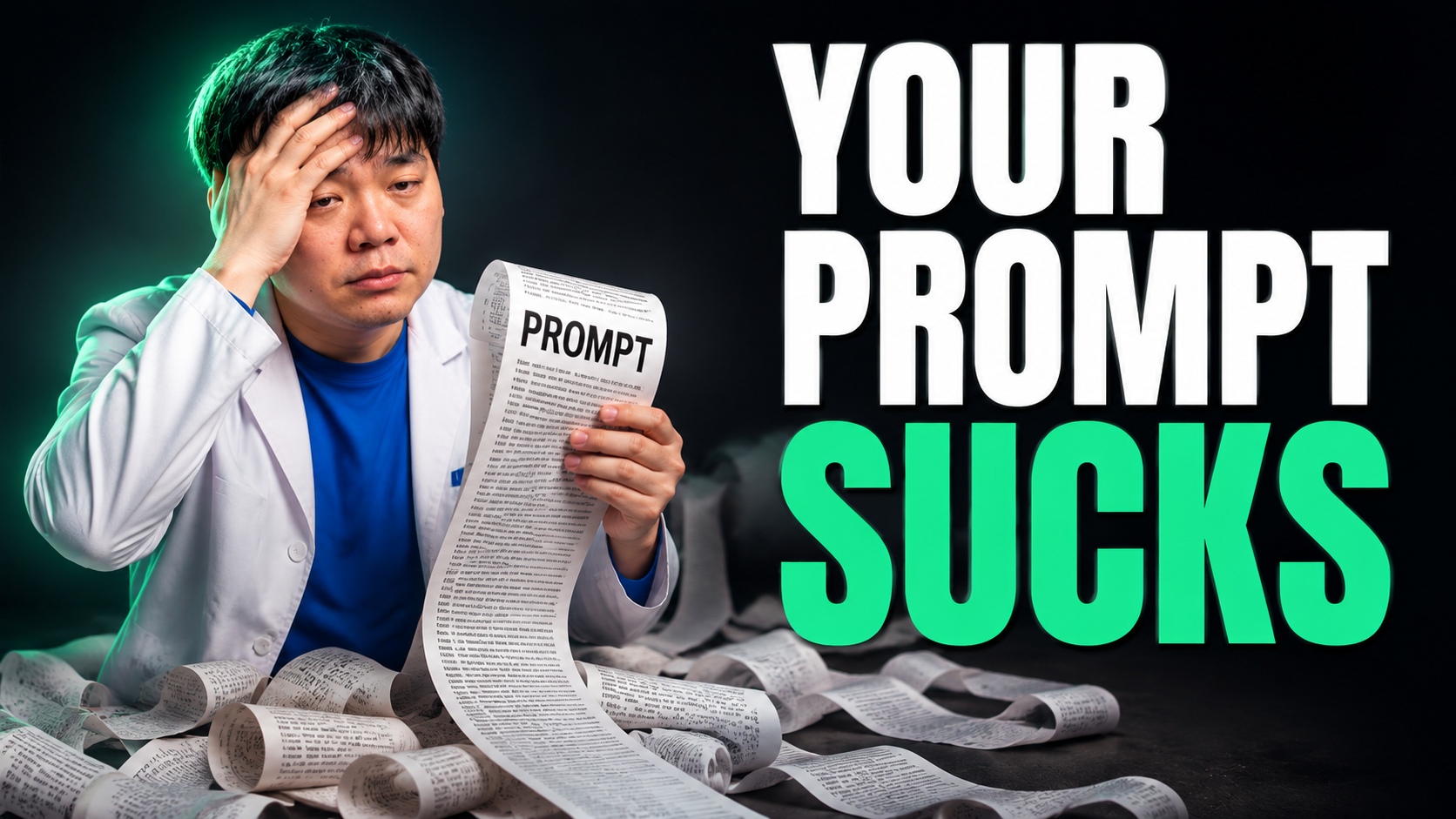
How long is the prompt you used to write your last ad? If the honest answer is three paragraphs of role-play, tone instructions, and a list of rules the model keeps half-ignoring, you're working harder than the people getting better output than you. And you're paying for it in hours.
I see this constantly. Smart marketers spend forty minutes engineering the perfect mega-prompt, paste it in, get something generic back, then spend another forty minutes wrestling it into shape. The prompt got longer every time something disappointed them. More rules, more constraints, more "you are a world-class direct-response copywriter with 20 years of experience." And the output barely moved.
Here's the thing. The length of the prompt was never the problem, and it was never the fix. The problem is direction. You're pushing the model toward an output when you should be pulling an output out of it.
Let me explain the flip, then give you the actual prompts our team runs for angle research and ad copy.
Why the giant prompt fails
The instinct to over-specify comes from a real place. Eighteen months ago you genuinely did have to shape the model hard to get anything usable. That advice was correct then. It's wrong now, and the models moved faster than the habit did.
What happens when you front-load a prompt with everything is that you do all the thinking up front and force the model into a box before it knows anything useful about your product. You've decided the angle, the tone, the structure, the hook style. So it returns exactly what you told it to, which is your average idea written competently. You can't get a better idea than the one you walked in with, because you never gave it room to have one.
There's a quieter cost too. Every one of those bloated prompts is tokens, and every wrestling round is more tokens, and that's real money across a team running creative at volume. Fewer, sharper prompts cost less and produce more. The over-engineering is expensive twice: your time, then the spend.
The flip: start with the outcome, let it ask the questions
The move is to tell the model what you want at the end and let it work out what it needs from you to get there. Outcome first. Then you let it interview you.
The single most useful sentence I've added to our workflow is this one, tacked onto the end of a short brief:
Before you write anything, ask me any questions you need to give me the best possible result.
That's it. Instead of you guessing what context matters and stuffing it all in pre-emptively, the model tells you what it's missing. It'll come back with a list - who's the customer, what's the core mechanism, what's the offer, what's the one objection that kills the sale. You answer those, and the answers are far more useful than anything you'd have thought to include, because the model asked for exactly the gaps it had.
And how specific you are in those answers is how good the output gets. That's the whole game. The reverse-prompt makes specificity easy because you're answering pointed questions instead of staring at a blank box trying to remember everything that matters.
This works for a reason worth holding onto: you still have to know your customer and your product cold. The AI doesn't replace the thinking. It just stops you having to format the thinking into a perfect instruction up front. If you don't know what to say or why you're saying it, no prompt length saves you. The writing is just fluff on top of a strategy you haven't done.
Prompt 1: build the context doc once, reuse it forever
Before any copy, our team builds two reference docs per client and reuses them across every brief that month. This is the unglamorous part that makes everything after it good.
The first is a product doc. We hand the model the live product page and ask:
Here's my product page. Analyse it and tell me everything about the product - features, benefits, how it works, who it's for, and pull out the strongest review quotes. Describe the product to me as if I can't see it.
That last line sounds odd and it's deliberate. Forcing a plain physical description catches details the marketing copy skips. We paste the result into a doc and keep it.
The second is a research doc, and this is the one that actually decides whether your ads land. We go where customers complain in their own words - Reddit threads, long reviews, the one-star and three-star sections on competitor listings, because that's where people get specific about what they hate. We pull real headlines that jump out, the different types of buyer, the desires underneath the complaints, and what people say is wrong with every other solution. That reading is still manual. It's the one part I won't hand to a model, because the judgement of what's a real signal versus noise is the actual skill.
Two or three pages of that beats a thirty-page prompt every time.
Prompt 2: rank the angles before you write a word
With both docs built, the highest-return prompt isn't "write me an ad." It's making the model sort the opportunity first. We open a fresh chat, attach the two docs, and lock it down:
These two docs are everything you're allowed to use - the research and the product info. Don't use prior knowledge, outside sources, or anything not in these files. Restate the rules back to me so I know you've got them.
Then:
As a high-level marketing manager whose only job is to grow this brand's revenue, rank the angles from these docs most to least likely to convert, and tell me why for each.
Now you're not staring at a blank page. You've got a ranked list of angles pulled from what real customers actually said, ordered by likely impact. You pick the top one or two and only then start writing. This is the difference between AI that guesses and AI that's working off evidence.
Prompt 3: write in a real voice, not "pretend to be"
When it's time for the actual copy, a small wording change matters more than it should. Don't write "pretend to be a copywriter." Write the persona as a fact:
As a [specific customer type] who has lived this exact problem, write me five hooks for angle one.
Telling the model it is the person, with detail attached, produces sharper output than asking it to pretend. "A busy parent who gave up on beetroot powders because every one upset their stomach" gets you something real. "A copywriter" gets you something that sounds like an ad.
Then you narrow with intent. If a hook drifts off the angle, say so:
Cut any hook that doesn't hit the specific pain in angle one.
You're curating, not accepting. The model's job is to generate options. Yours is to know which one is true, and that judgement is still entirely human.
Prompt 4: mine the product by talking to it, one line at a time
There's a second style worth having in your kit, and it's gentler than dumping docs in. You have a conversation. Send the model the product link and set the rules of the chat:
Let's have a conversation about this product. Answer one sentence at a time, as concise as you can. Who is this for? Then I'll ask why, then how.
So it says who it's for. You ask why. One sentence. You ask how. One sentence. You ask for an analogy, an example, what you should know before the next question. You're mining the product the way you'd interview a founder, and you write the good lines into your notes as they come. By the end you've got raw material in plain language that you can build copy from, and none of it sounds like it came off a spec sheet.
The two best uses of a model in copywriting, honestly, are this and the opposite: asking it questions to pull information out, and handing it your long clumsy sentence to make tight. Mine, then trim. Most of the value is in those two jobs, not in asking it to write the whole thing cold.
Where this breaks, and what it never replaces
I'll be straight about the limits, because the people selling AI prompt packs won't.
Reverse prompting makes a model fast and specific. It does not make it know your customer. If you skip the research - the real reading of what real people complain about - the model will happily interview you and write beautiful copy off a hollow brief, and it'll convert like a brick. Garbage context in, polished garbage out.
It also won't make the taste calls. Which hook is true, which angle is worth the spend, which line a real customer would actually say out loud - that's still you. The model widens the funnel of options. You're the one who picks.
So maybe the question to sit with isn't how to write a better prompt. It's whether you actually know your customer well enough that a good model, asked the right way, could pull a winning ad out of you in ten minutes. If the answer's no, that's the work. The prompt was never the bottleneck.


Recent Insights®



.webp)

Powered by © Pigeon Digital 2026. All rights reserved.
We acknowledge the Traditional Owners of the land on which we work, the Wurundjeri Woi Wurrung Cultural Heritage Aboriginal Corporation people of the Kulin Nation, and pay our respects to Elders past and present. We recognise their continuing connection to Country, culture and community.
.svg)