Bundle, Don't Discount: The Black Friday Offer Math That Protects Your Margin

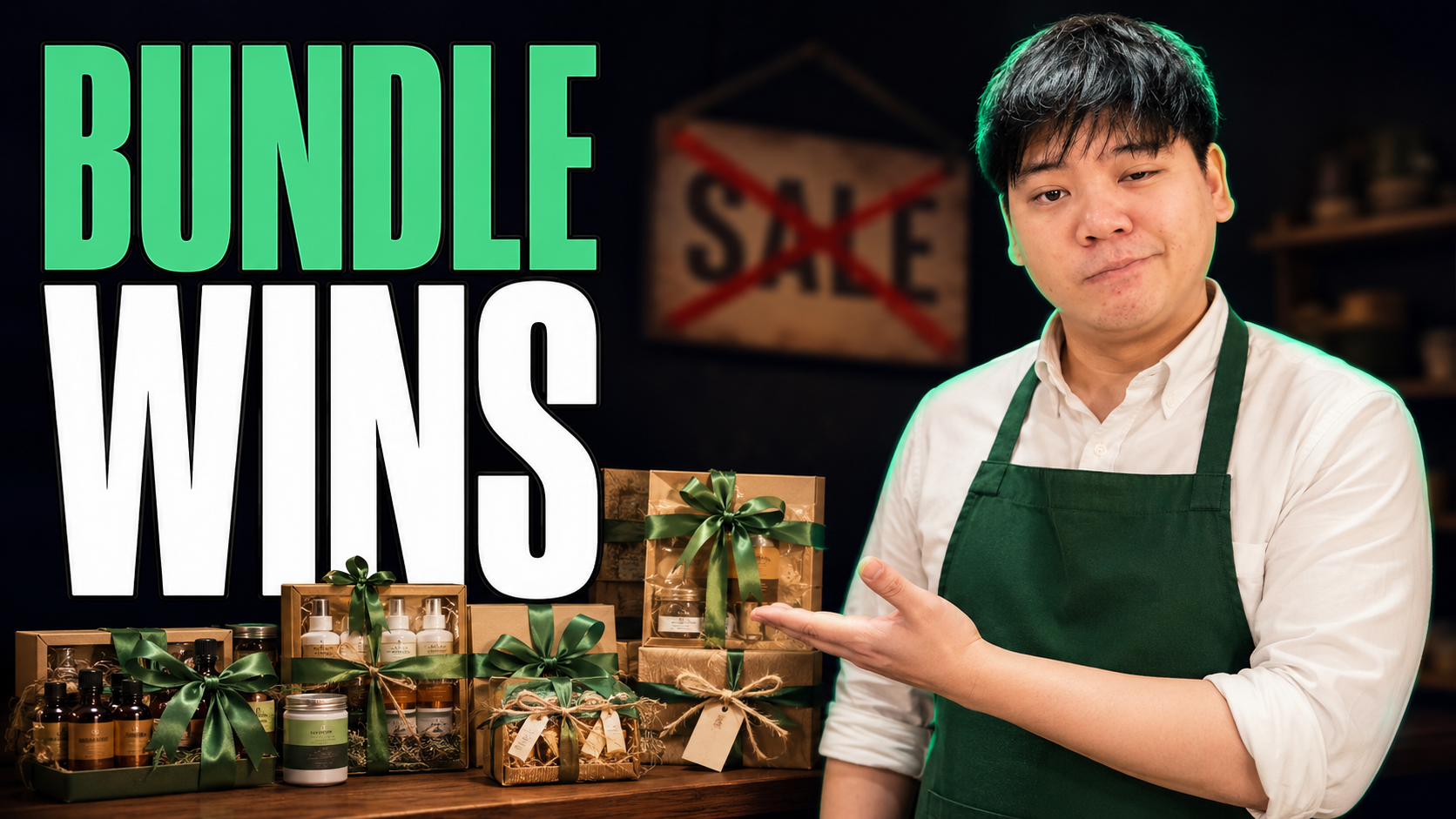
What's your actual Black Friday plan this year, the one you'd say out loud right now if I asked? For most brands it's "sitewide 30% off, maybe 40% if we're feeling brave." Be honest, that's the default sitting in your calendar.
Here's the thing about that default. It's the single fastest way to take your best sales week of the year and turn it into your thinnest-margin week of the year. You can do better than a blanket discount, and the maths isn't even hard.
Let me walk through it the way I'd talk it through with a brand the week before they lock their offer in.
What a flat discount actually costs you
Discounts don't come off your revenue. They come off your margin, and that's a much smaller number to be carving into.
Picture a homewares brand. Average order is A$80. Cost of goods, shipping, fees and fulfilment come to about A$48 on that order. So your contribution, the cash left to cover everything else and turn a profit, is A$32 per order. That's 40% of the order value.
Now run a sitewide 30% off. The customer pays A$56 instead of A$80. Your costs don't move, they're still A$48. So your contribution drops from A$32 to A$8.
Read that again. A 30% discount didn't cut your profit by 30%. It cut it by 75%. You're now keeping A$8 where you used to keep A$32, and you're working ten times harder to do it because it's Black Friday.
That's the trap with blanket discounts. The headline number sounds reasonable, "it's only 30%", but it's 30% off the wrong thing. The discount eats contribution dollars at a brutal rate, and the thinner your margins were to start with, the closer to zero you get.
So the goal for BFCM isn't "what discount can I afford." It's "how do I give real perceived value without gutting my contribution per order." Bundling is the cleanest way I know to do that.
Why a bundle protects what a discount destroys
A discount lowers the price of one thing. A bundle changes what's in the cart. That difference is the whole game.
When you build a "buy more, save more" or a build-your-own-bundle offer, you're not just shaving the price. You're growing the order. And a bigger order absorbs a discount far better than a small one, because your costs don't scale up as fast as your cart value does.
Back to the homewares brand. Instead of 30% off everything, you run: build a bundle of three items, get 20% off the bundle.
Say a customer builds a A$120 bundle, three items they might've bought one of. Costs on that A$120 of product are around A$72, keeping the same ratio. Apply 20% off and they pay A$96. Your contribution is A$96 minus A$72, which is A$24.
Compare the two worlds. Single item, 30% off: you keep A$8. Three-item bundle, 20% off: you keep A$24. Three times the contribution, and the customer feels like they got the better deal because the percentage off is sitting on a bigger, more exciting purchase.
That's the bit founders miss. A smaller discount on a bigger basket beats a bigger discount on a single item, almost every time. The customer's "I saved money" feeling goes up while your "I kept my margin" reality also goes up. Both sides win, which is exactly what a good offer is supposed to do.
The framing that makes people actually bundle
A bundle offer only works if people take it, and that comes down to how you frame it, not just the discount sitting underneath.
The phrase I keep coming back to is contextual value. You're not asking someone to buy more so you can hit your numbers. You're giving them a reason that makes buying more feel like the smart, obvious move for them.
Black Friday hands you that reason for free, because it's right before Christmas. So the bundle stops being "spend more, save more" and becomes "sort your gifting in one go while it's cheapest all year." Same offer. Completely different justification in the customer's head.
Here's my take on why this matters so much. People make the purchase on emotion, then look for a logical reason to back it up. Contextual value is you handing them that logical reason on a plate. "It's the perfect time to stock up for the people on your list" does more work than another 10% off ever could, because it turns a bigger basket from an indulgence into a sensible decision.
So when you write the offer, lead with the clear deal, then layer the context on top. The deal gives them permission. The context closes the gap between wanting it and justifying it.
When a free gift beats a discount entirely
There's a version of this that protects margin even harder than a bundle, and it's the one I'd push most brands toward if their numbers allow it. A gift with purchase.
I'll show you why with an example. Take a skincare brand whose hero serum sells for A$60 and costs them about A$12 to make. That's a product with a lot of room in it.
Option one: sitewide 25% off. On a typical A$90 order, that's A$22.50 straight out of contribution. Gone, every order, no strings.
Option two: spend A$90, get a free travel-size of the hero serum. That gift has a A$25 perceived value to the customer, because that's roughly what they'd pay for it. But it only costs the brand around A$5 to include, because they're giving away cost price, not retail price.
Look at what just happened. The customer perceives A$25 of extra value, more than the A$22.50 they'd have got from the 25% off. But it cost the brand A$5 instead of A$22.50. That's A$17.50 of contribution saved on every single order, while the customer arguably feels like they got the better deal.
That's the quiet beauty of a gift with purchase. The gap between what the gift is worth to them and what it costs you is pure protected margin. And it often lifts average order value too, because the gift threshold gives people a reason to add one more thing to clear it.
I'm not saying GWP beats a discount in every situation. If your margins are genuinely thin, even cost-price gifting can sting, and you need to run your own numbers before you commit. But if you've got a hero product with decent margin in it, a free gift will usually defend your contribution far better than knocking a percentage off the whole store.
The email sequence I'd run around it
A great offer with a weak send schedule still underperforms. BFCM is one of the only moments in ecommerce that feels like a championship game, a fixed day you've either prepared for or you haven't, so the sequence matters as much as the offer.
Here's the rhythm I'd run, assuming you've spent the prior weeks actually giving your list value rather than going quiet:
- Early access, a day or two before. Reward your most engaged subscribers and your VIPs with the bundle offer first. It respects the people who've been with you and it pulls revenue forward before the inbox gets crowded.
- The main launch email. Lead with the offer stated plainly, the bundle or the gift, then layer the contextual value, the gifting angle, the "best price all year." Clear first, context second.
- A mid-window nudge. Social proof and momentum. "It's going faster than we expected" works because it's usually true, and real scarcity reads completely differently to manufactured urgency.
- The last-call send. Straightforward, a bit urgent, no apology for emailing again. The people who were going to buy and hadn't yet are waiting for exactly this permission. Don't deny them it.
The brands that win BFCM aren't the ones that discount hardest. They're the ones that treated their audience with respect for the weeks beforehand, then showed up with a high-value offer framed so well it barely needed selling.
Run your own version this week
Everything here used round, invented numbers to keep the maths readable. Your real cost of goods, your real average order, your real hero-product margin, those are the figures that decide which of these actually protects your contribution best.
So here's what I'd do this week, before you lock anything in. Take one product. Work out your true contribution per order, all costs in. Then model the three options side by side: your default sitewide discount, a build-your-own-bundle, and a gift with purchase. Look at what each one leaves in your pocket per order, not just what it does to the top line.
I'd put money on the blanket discount coming dead last on profit. Most brands have never run that comparison, which is exactly why "30% off everything" is still the default. Run it once and the default tends to quietly retire itself.
If you do the exercise and your numbers surprise you, I'd genuinely love to hear which way they fell. It's the same modelling we do with brands before every BFCM, and the answer is almost never the discount.


Recent Insights®


.webp)

Powered by © Pigeon Digital 2026. All rights reserved.
We acknowledge the Traditional Owners of the land on which we work, the Wurundjeri Woi Wurrung Cultural Heritage Aboriginal Corporation people of the Kulin Nation, and pay our respects to Elders past and present. We recognise their continuing connection to Country, culture and community.
.svg)