The Two Documents Every Ecom Brand Needs Before AI Can Write a Single Ad

A couple of years back I sat down to write a batch of ads for a supplements brand, opened ChatGPT, and typed something like "write me five Facebook ad hooks for a greens powder." What came back was fine. It was also completely useless. Every line could have been for any greens powder on the planet. "Fuel your day the natural way." "Nutrition made simple." Beige, safe, and instantly forgettable.
I did what most people do. I blamed the tool, added more instructions, told it to be punchier, told it to sound like a world-class copywriter. It got slightly less beige and still said nothing a real customer would react to.
Here's the thing I worked out the hard way. The model wasn't the problem. I'd asked it to write about a product it knew nothing about, for a customer it had never met. Of course it sounded like a robot. It was guessing.
This is the single most common reason people end up convinced they can't get ChatGPT ad copy without sounding AI. They're skipping the part that makes the copy good, and it has nothing to do with prompting tricks.
Why AI copy reads like AI
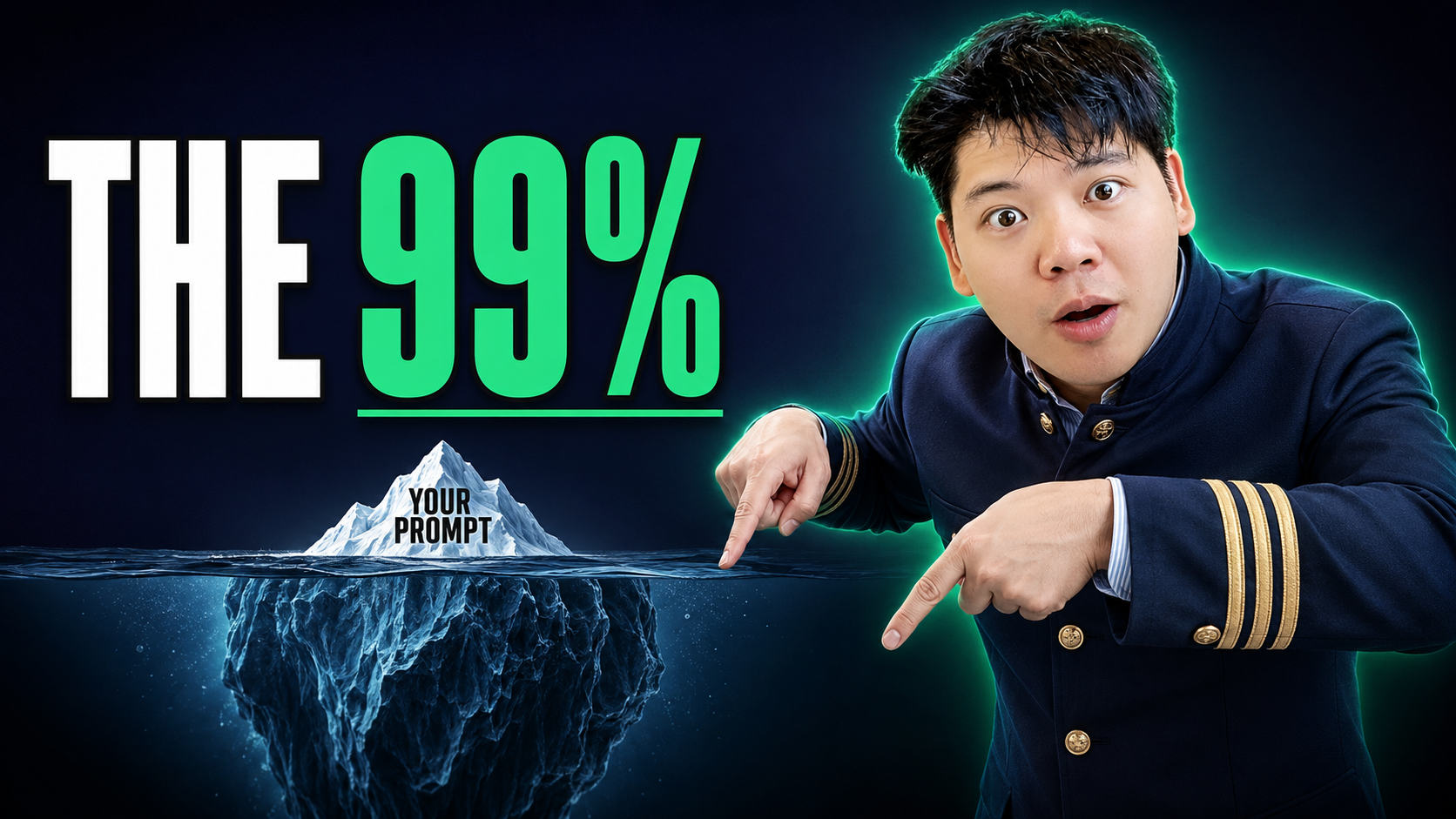
Good copy is mostly not the words. The words are the tip of the iceberg. Underneath them sits the 99% that actually does the work, which is understanding the person you're selling to better than they understand themselves. What they're afraid of. What they've already tried. What they secretly want. The exact phrase they'd use to describe the problem to a friend.
A language model can't reach into your customer's head and pull that out. By default it doesn't have it, so it fills the gap with the most average version of everything. The result is grammatically perfect and strategically empty.
So the fix isn't a cleverer prompt. It's giving the model the two things it's missing before you ask it to write anything: a deep understanding of your product, and a deep understanding of your market. We hold those in two separate documents, built once per client, and we reuse them across every brief that month. They're the foundation everything else sits on.
I'll walk through both, then show you what they do to brief-production speed in practice.
Document one: the product-info doc
This one sounds boring and it's the reason your ads can be specific instead of vague.
The goal is a single document that holds everything true about the product. Not the marketing spin. The actual facts. What it is, what it's made of, how it works, what it costs, what's in the box, the guarantee, the offer, who it's genuinely for and who it isn't.
The fastest way to build the first draft is to hand the model your live product page and ask it to do the heavy lifting:
Here's my product page. Pull out every feature and the benefit behind each one, how the product works, what makes it different, who it's for, and the strongest lines from the reviews. Then describe the product to me in plain language, as if I've never seen it.
That last instruction is the one people skip, and it's the most useful. Forcing a plain physical description catches the boring details that marketing copy glosses over, and boring details are where believable ads come from. The texture. The smell. How long it lasts. What it replaced in someone's routine.
Then you correct it. The model will get things wrong or miss what matters, and you fix that by hand. You add the offer properly. You add the stuff that isn't on the page, like the founder's reason for making it, or the one ingredient you're genuinely proud of. Ten minutes of editing here saves you from generic ads forever.
You keep this doc. Every time you sit down to write for that brand, it goes in first. The model is now working from your product, not its vague idea of "a greens powder."
Document two: the market-research doc
If the product doc makes your ads accurate, this is the one that makes them land. It's also the one almost nobody does properly, which is exactly why it's worth doing.
The market-research doc holds how real customers actually talk. Their words, not yours. And you can't get this from the product page, because the product page is the brand talking about itself. You have to go where customers are unfiltered.
For us that means reading, manually, in the places people get specific:
- The one and three-star reviews, on your listings and your competitors'. Five-star reviews tell you what's nice. The low ones tell you what people are furious about and what every other product got wrong. That's gold.
- Reddit threads and forums where people ask for recommendations and complain in full sentences.
- Comments on competitor ads, where the objections show up raw.
- Your own support tickets and sales calls, if you have them, because that's the real language of someone about to buy or about to bail.
As you read, you're collecting four things into the doc. The different types of buyer (they don't all buy for the same reason). The desires sitting underneath the complaints. The exact phrases people use, copied word for word. And what people say is wrong with every other solution they've tried.
I want to be honest about this part, because it's where the temptation is strongest. You cannot fully hand this to AI. You can ask a model to summarise a pile of reviews you've already gathered, sure. But the judgement of what's a real signal versus noise, which complaint is a throwaway and which one is the thing keeping people up at night, that's the actual skill. It's the difference between copy that sounds human and copy that sounds like it read about humans.
Two or three pages of this, written in your customers' own words, will beat a thirty-page mega-prompt every single time.
How the two work together
With both docs built, you stop asking the model to write cold and start asking it to work off evidence.
A fresh chat, both documents attached, and a hard boundary first:
These two docs are the only things you're allowed to use, the product info and the market research. No outside knowledge, no assumptions, nothing that isn't in these files. Tell me the rules back so I know you've got them.
Then, before any copy at all, you make it sort the opportunity:
Acting as the marketing lead whose only job is to grow this brand, rank the angles from these docs from most to least likely to convert, and tell me why for each one.
Now you're not staring at a blank page. You've got angles pulled from things real people actually said, ranked by likely impact. You pick the top one or two, and only then do you ask for hooks. And because the model is writing from the research doc, the hooks come back in customer language instead of brand language. The difference is night and day.
What this does to brief speed
Here's the part that makes founders pay attention, because it's not just about quality. It's about how much you can produce.
Picture a brand that used to turn around maybe four or five solid ad briefs in a week, because each one meant starting research from scratch, remembering the angles, wrestling the copy into shape. Slow, and the quality bounced around depending on how fresh the writer was.
Once the two docs exist, the research is done. It lives in the documents. So a new brief stops being "research plus write" and becomes "pick an angle and write." We've watched that take a team from a handful of briefs a week to comfortably two or three times that, without the quality dropping, because the thinking already happened and got stored.
That's the real return on the two documents. You do the hard part once. Then every brief after it is faster and better, instead of you re-earning the same understanding every time you open a blank chat.
To be clear, I'm not promising a specific multiplier for your brand. The exact lift depends on how messy your starting point is. But the shape of it holds: front-load the understanding into two reusable docs, and everything downstream gets quicker.
Where this falls down
I'll be straight about the limits, because the people selling AI copy templates won't.
The two documents make a model specific. They don't make it have taste. Which angle is actually worth the spend, which hook a real customer would say out loud, when to throw the whole thing out and start again, that's still you. The model widens your options. You're the one who picks the winner.
And the docs are only as good as the reading behind them. If you rush the research, or worse, ask the AI to invent it, you'll get a beautifully written brief built on a hollow foundation, and it'll convert like a brick. Thin context in, polished nothing out.
So before you go hunting for a better prompt, the more useful question is whether you actually know your product and your customer well enough to fill those two documents with something real. If you do, a decent model will write you ads that sound like a person. If you don't, that's the work, and no prompt will do it for you.
If you'd find it useful to have someone look over the angles you're already running and tell you which ones are pulling their weight and which are just noise, that's exactly what a Signal/Noise Audit is for. No pitch, just a clear read on where the wins are hiding.


Recent Insights®

.webp)

Powered by © Pigeon Digital 2026. All rights reserved.
We acknowledge the Traditional Owners of the land on which we work, the Wurundjeri Woi Wurrung Cultural Heritage Aboriginal Corporation people of the Kulin Nation, and pay our respects to Elders past and present. We recognise their continuing connection to Country, culture and community.
.svg)