
The Replacement-Cost Test: What Your Time as In-House Media Buyer Is Really Costing You

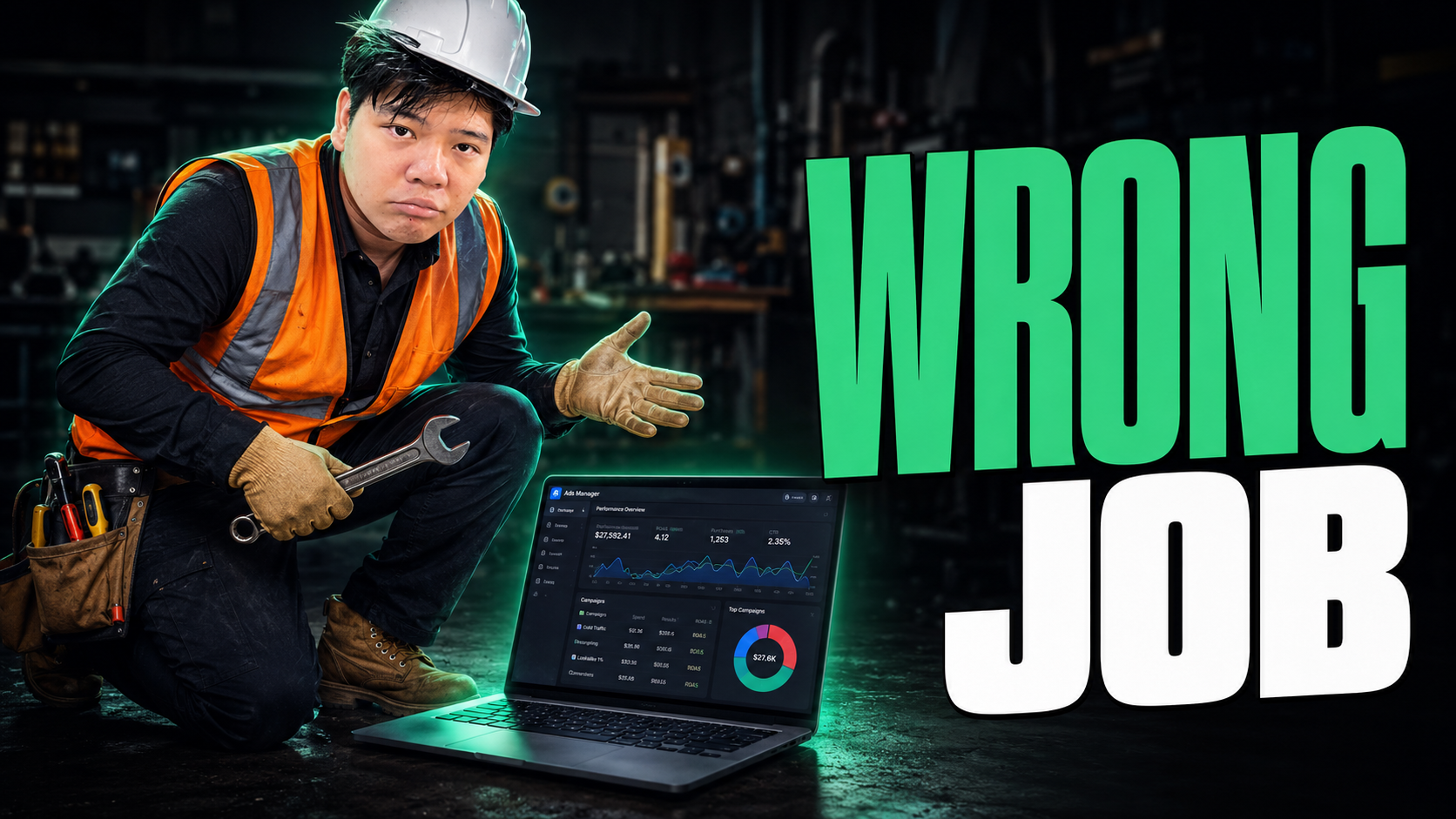
A mate of mine is a plumber. Owns the business, has four blokes on the vans. He spent two weekends last year re-doing the pipes in his own bathroom because, in his head, that work was free. He already owns the tools. He's already paid for. Why pay someone?
But his time on a Saturday is worth a few hundred dollars an hour to his actual business. The "free" bathroom cost him a fortune. He just never saw the invoice because it never got written.
I think about this constantly with founders who run their own Meta ads.
You're in the account every morning. You're writing the briefs, checking the spend, killing the bad ads, refreshing the dashboard. And in your head it's free, because you're not cutting yourself a cheque for it. But there's an invoice. It just never gets written.
So let's write it. Here's a test I'd run on yourself before you decide whether to keep buying your own media, hire someone in-house, or bring in an agency.
1. Work out your real hourly rate
Forget what you pay yourself. That number is irrelevant here.
Take your annual revenue and divide it by the hours you actually work in a year. Call it 2,000 hours if you're full time and reasonably sane about it. That's your real hourly rate - the impact you're having, not the salary you're drawing.
A founder doing ~$2.4m a year is operating at roughly $1,200 an hour. A founder at ~$600k is at ~$300 an hour. Even a relatively young brand at ~$240k is sitting around $120 an hour.
I heard a version of this framing on a podcast with a few nine-figure operators and it stuck with me, because it reframes everything. If you run a real company and you're still doing $30-an-hour tasks, that's not thrift. That's poor management of the most expensive resource you've got.
So the first number you need is honest: what is an hour of your time actually worth to the business?
2. Count the hours the ads actually eat
Be honest here too, because this is where most founders fool themselves.
It's not just the hour a day in Ads Manager. It's the brief you wrote on Sunday night. The three creatives you reviewed. The half-hour you lost to a sudden ROAS dip that turned out to be nothing. The mental tabs you're keeping open while you're meant to be doing something else entirely.
Most founders I talk to who "only spend an hour a day" are closer to 12-15 hours a week once you count the context-switching. Call it 600 hours a year.
Now multiply. The founder at $300 an hour, running their own ads for 600 hours, is spending ~$180k of their own time on media buying. The founder at $1,200 an hour is spending ~$720k.
That's the phantom salary. Nobody invoices you for it, but you're paying it every single month in the highest-value hours you own.
3. Compare it to what a replacement actually costs
Here's the bit that makes the test useful. The right question was never "can I do this myself". Of course you can. The question is what it would cost to replace you on this one job, and whether your hours are better spent elsewhere.
I borrow this straight from how buyers value a business. When someone buys your company, they don't care that you paid yourself a low salary to run it. They look at it and go, "right, I have to replace this person with someone who'll cost $X," and they adjust the price accordingly. They value you at replacement cost.
So value yourself the same way on media buying specifically.
- A competent in-house media buyer: somewhere around $90-130k a year all in, once you add on-costs, plus the ramp time and the management you'll need to give them.
- A good agency: a monthly fee that, on a brand spending ~$50k/month, often lands somewhere in the low-single-digit thousands.
- You: 600 hours of the most expensive time in the company.
Now you've got three real numbers instead of one imaginary "free". Line them up against your hourly rate and the maths usually makes the decision for you.
4. Run the honest threshold (this is where it cuts both ways)
I'm not going to pretend the answer is always "hire an agency". It isn't, and I'd lose your trust fast if I said so.
Here's my honest read on the thresholds:
Under ~$30k/month in spend, doing it yourself is often correct. Your hourly rate is real but the absolute dollars are small, the account isn't complex, and frankly nobody will care about your brand at 2am the way you do. At this stage the constraint is usually creative volume and product, not account management. Keep your hands on it. Learn the platform properly. It'll make you a better operator forever.
Around ~$30-75k/month, you've hit the messy middle. The hours are eating real value, the account now has enough moving parts that mistakes cost money, but you can't yet justify a senior in-house hire who'll want a serious salary. This is where an agency tends to make the cleanest sense, because you're renting capability you can't afford to buy outright.
Above that, it's a portfolio decision. Some brands build a strong internal team. Some keep an agency for the media buying and creative engine and run everything else in-house. There's no single right answer, only the one that frees up your hours for the work only you can do.
The point of the test isn't to push you one way. It's to stop you defaulting to "free" when free is the most expensive option on the table.
5. Sanity-check the proxy you're actually optimising
One last step, because this is the trap I see smart founders fall into.
When you run your own ads, the work itself starts to feel like the goal. You get a little hit from being in the account. You tell yourself the daily tinkering is what's driving the result. But the dashboard is a proxy. The actual goal is profitable growth and a business that doesn't depend on you sitting in Ads Manager.
It's the same mistake as a founder optimising their email opt-in rate when what they really wanted was more customers. You can win the proxy and lose the thing the proxy was meant to point at.
So ask yourself plainly: in the hours you spend on the account, are you driving the outcome, or are you just refreshing a number you've decided to worship? Because if it's the latter, that's 600 hours that could go to the one or two things in your business that genuinely don't work without you.
Where to from here
Run the test on yourself this week. Real hourly rate, real hours the ads eat, real replacement cost. Write the invoice you've never written.
If the maths says keep doing it yourself, brilliant - do it with a clear conscience and stop feeling guilty about not "outsourcing". If the maths says your hours are bleeding value, you've at least seen the number instead of pretending it's zero.
And if you genuinely can't tell whether your account is the thing holding you back or the thing you're hiding in, that's usually the moment a fresh read pays for itself. A Signal/Noise Audit will lay out where your account actually stands - the unit economics, the creative history, the gaps - so you can decide where your 600 hours should really go. No pressure either way. Sometimes the honest answer is "keep your hands on it a bit longer", and I'll tell you that too.
What's your real hourly rate, and how many hours a week is the account quietly taking from it?


Recent Insights®



.webp)

Powered by © Pigeon Digital 2026. All rights reserved.
We acknowledge the Traditional Owners of the land on which we work, the Wurundjeri Woi Wurrung Cultural Heritage Aboriginal Corporation people of the Kulin Nation, and pay our respects to Elders past and present. We recognise their continuing connection to Country, culture and community.
.svg)