
Your Founder Has More Followers Than Your Brand. Use That.

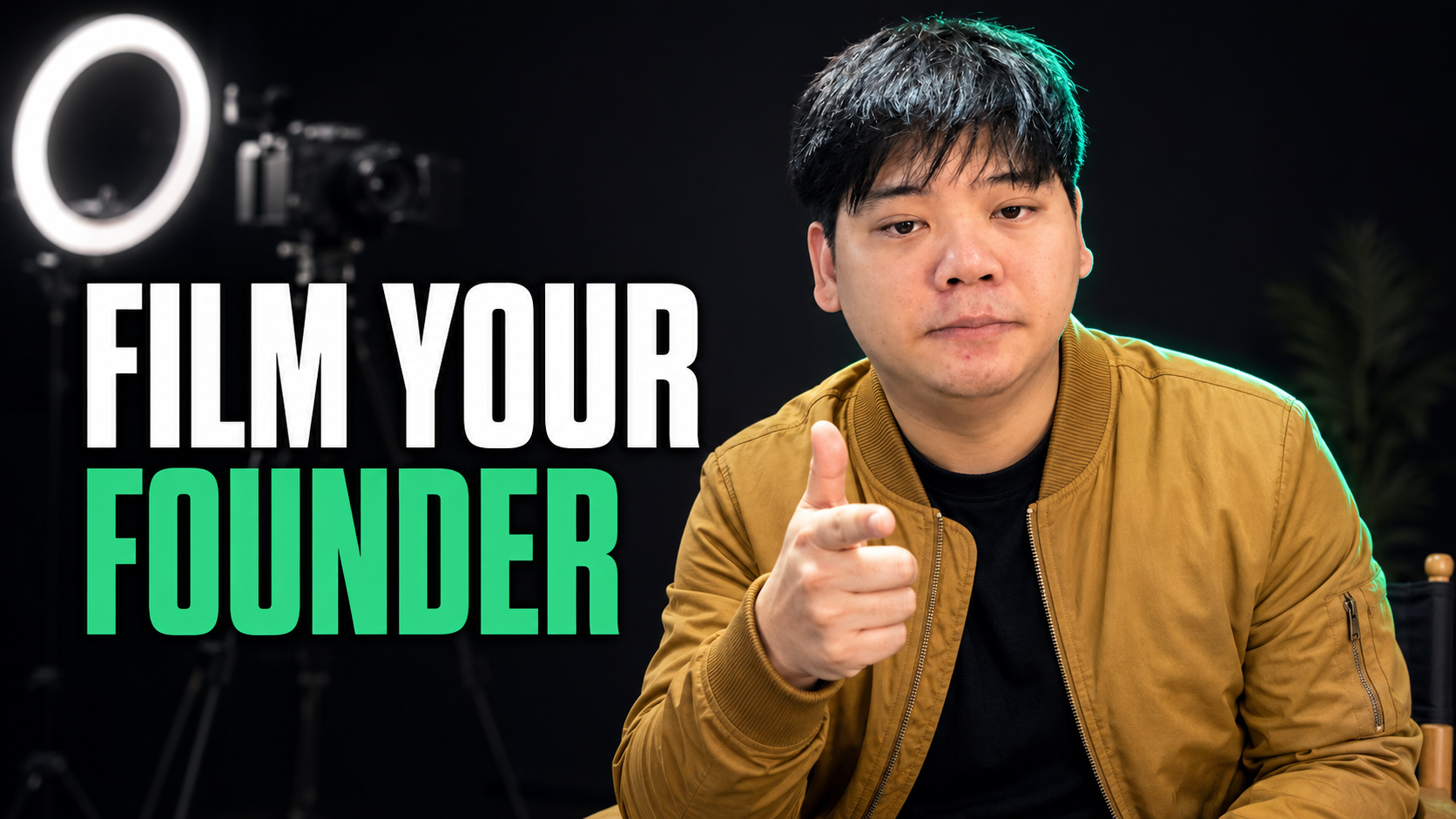
Think about the last gig you went to. People didn't pack the room for the logo on the bass drum. They came for the person at the front holding the mic. The brand was on the ticket. The human was the reason anyone showed up.
That's the bit most ecommerce brands get backwards. They pour the budget into the polished brand ad, the thing with the logo on the bass drum, and they leave the lead singer sitting backstage. Meanwhile that lead singer, your founder, very often has more followers and more pull than the brand account does.
Here's my take: if your founder has a bigger, warmer audience than your brand, the brand should be borrowing the founder's face, not the other way around. And the cheapest, most repeatable way to do that is to film founder content and run it as paid.
Let me walk through how I'd actually set that up.
Why founder content beats the polished brand ad
Start with the asymmetry, because it's bigger than people think.
I keep seeing the same shape. A founder's personal account sits at, say, ~35k followers built off them just being a person online. The brand account they spent two years and real money building sits at ~2.5k. Same business. The human pulls ten times the audience of the logo, and nobody's pointing a camera at the human.
Why does the human win? Because people follow people, then they follow companies. Have a look at your own Instagram or your own feed. You follow individuals. You follow the brand maybe to get a discount code. The follow that carries actual trust is almost always a person.
There's a second reason, and it's about feeling something. So much brand content gets sanded down in approvals until it's smooth and safe and says nothing. Everyone signed off, nobody felt a thing, and the viewer scrolls straight past. A founder talking like an actual human, with an opinion, occasionally a bit awkward on camera, gets a reaction. And a reaction, even a slightly polarising one, beats being ignored. I'd rather a piece of content make a few people roll their eyes than have everyone feel nothing.
That awkwardness is a feature, by the way. A founder who clearly isn't a trained actor reads as real, and real is exactly what the polished spot can't fake. The slightly-rough founder clip is doing a job the A$50k brand film can't buy its way into.
On a pure performance basis this is why founder-face content so often comes in cheaper on cost per acquisition than the beautiful brand piece. It stops the scroll because it looks like a person, not an ad. It earns trust because it is a person. And it's a fraction of the cost to make.
Step one: whitelist the founder content as a Meta ad
This is the move most brands miss, so I'll be specific.
Whitelisting means you run the ad through the founder's personal handle rather than the brand page. The post shows up as coming from your founder, with their name and face on it, but it's a paid ad you control, target, and scale like any other.
Why bother instead of just posting it organically? Two reasons. Organic reach is a lottery now, so a great founder clip might reach a tiny slice of their followers and then die. And running it as paid means you put real budget behind the pieces that work, to cold audiences who've never heard of either the founder or the brand. You get the trust of a person's account with the reach of a paid campaign. That's the combination.
So the rule I'd write down: anything the founder films is a paid asset first, an organic post second. You're not making content for the founder's followers. You're making content that happens to wear the founder's face, pointed at people who aren't following anyone yet.
Step two: get the founder on camera with a batch-film system
Here's the real objection. Founders are flat out. They are not going to film a little something every day, and if you ask them to, it falls apart inside a fortnight. The daily content hamster wheel is where good founder-content plans go to die.
So don't run it daily. Batch it.
The system I rate is filming in concentrated blocks. Roughly seven days every two months, the founder blocks out the time, a videographer comes to them, and you shoot everything in that window. In one week like that you can comfortably walk away with a dozen-plus longer pieces, a pile of short-form cuts, and a stack of ad variations, enough to feed the account for the next two months.
A few things that make the week actually work:
- Print the briefs. The founder shouldn't be writing scripts on the day. Each topic gets a short brief, printed, so they can read it over a coffee that morning, scribble a note, then just turn it on and talk. No staring at a blank page on set.
- Pull topics from your real customers, not your own head. The best founder content answers what actual buyers ask. Survey your customers with three questions: what's their biggest challenge, what's their main goal, and if they could wave a wand and have you fix one thing, what would it be. Film around those answers. Now the content lands because it's aimed at things people genuinely care about.
- Let the founder talk first, then build the brief around that. A trick I like: before the shoot, get the founder to record a rough five-minute voice note on each topic, just their honest take. Hand that to whoever writes the brief. The sharpest lines come straight out of how the founder actually talks, not how a copywriter imagines they talk.
Done this way, the founder is "on" for one focused week, enjoys it more because it's a sprint not a slog, and then gets back to running the business. Two months of paid creative out of seven days of their time is a trade most founders will take once they see it.
Step three: what the founder should actually say on camera
Filming is only half of it. The content has to say something, or you've just made expensive wallpaper.
Pick a lane and own it. The founders who break through tend to be known for one thing, said in lots of different ways, not ten things said once. Have one core pillar, the idea you want people to associate with you, and remix it endlessly. The same single idea becomes a how-to, a quick myth-buster, a behind-the-scenes, a reaction to something in your category. One pillar, a hundred angles. That repetition is how people come to know and trust you, rather than catching a different message every time.
And let the founder be a bit of a character. The most effective founder content I see has a point of view, a bit of humour, the odd strong opinion. It's okay to be funny, to be blunt, to film the bit where it's not perfectly polished. The version where the founder shows you behind the curtain, the honest "here's why I built this and here's what it cost me", is consistently the piece people connect with hardest. People want the real human, not the press release.
Step four: feed the winners into the ad account, kill the rest
Last piece, and this is the bit that turns it into a system instead of a vanity project.
Treat that week of founder footage as raw inventory for your ad account. You're not precious about any single clip. You launch a spread of them as ads, you watch which ones the cold audience actually responds to, and you put budget behind those. The founder's job was to give you a lot of honest swings. The account's job is to find the two or three that connect and scale them.
Be honest about the hit rate. Plenty of what you film won't work, and that's completely fine. The content is cheap enough, off the back of one batch week, that you can afford a low strike rate. The handful that land pay for all the ones that didn't, and now you've got a founder-fronted winner running to cold traffic at a cost per acquisition your polished brand ad probably can't match.
The honest part: this doesn't fit every founder
I'd be doing you a disservice if I pretended this works for everyone.
Some founders genuinely don't want to be the face, and forcing a deeply reluctant person in front of a camera produces stiff, lifeless content that performs worse than no founder content at all. If that's your founder, don't fake it. There are other faces you can build around, a team member, a customer, a creator.
And there's a taste bar here that AI and shortcuts won't clear for you. The reason founder content works is that it's authentically human, so the moment it feels manufactured, it loses the exact thing that made it valuable. This is craft, not a content-factory output. Good judgement on what to say and how to say it is the whole game, and that still has to come from a person with taste.
So the real question to sit with isn't "should we do founder content". It's quieter than that: who in your business already has the audience and the willingness, and are you pointing a camera at them or leaving them backstage while the logo plays to an empty room?
If you're not sure whether your founder's face is your most underused asset, that's exactly the kind of thing a Signal/Noise Audit surfaces fast. We'll look at your account, your creative, and where your cheapest untapped reach actually sits, no pitch, just a clear read on what's being left on the table.


Recent Insights®



.webp)

Powered by © Pigeon Digital 2026. All rights reserved.
We acknowledge the Traditional Owners of the land on which we work, the Wurundjeri Woi Wurrung Cultural Heritage Aboriginal Corporation people of the Kulin Nation, and pay our respects to Elders past and present. We recognise their continuing connection to Country, culture and community.
.svg)