Your Free Shipping Threshold Is Probably Killing Your Profit (and Punishing Your Cheapest Customers)

Two shoppers land on the same homewares store on the same afternoon. One drops a A$95 dinner set in the cart, sees "you're A$5 away from free shipping," tosses in a A$12 serving spoon, and checks out happy. The other wants a single A$32 tea towel set, sees "spend A$68 more for free shipping," does the maths on a A$9 postage charge that's nearly a third of their order, and quietly closes the tab.
Same store. Same threshold. One customer it nudged, one customer it taxed out of the building.
That second shopper is the one nobody talks about. And on most stores I look at, there are far more of them than the founder thinks.
The average is lying to you
Here's the trap, and almost everyone walks into it.
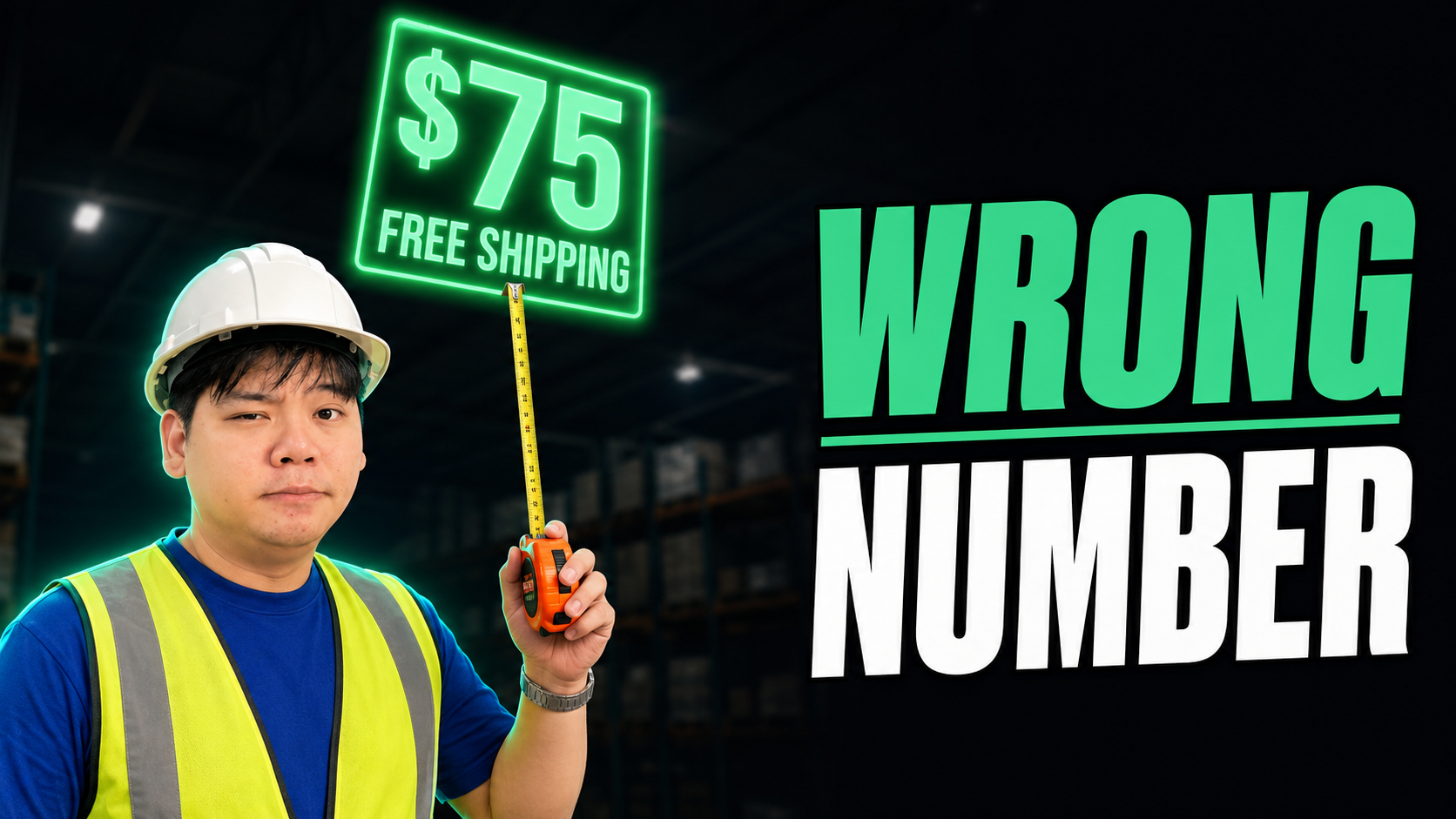
You set your free shipping threshold off your average order value. AOV is A$70, so you put the bar at A$75 to "encourage people to add one more thing." Tidy. Logical. Wrong for most of your customers.
Because your AOV is an average, and your orders aren't clustered politely around it. They're a distribution. You've got a fat lump of small orders, a fat lump of larger ones, and the mean sits in the thin gap between them where barely anyone actually shops.
A founder of a multi-category brand put it perfectly on a podcast recently. He sells A$350 wedding bands and A$29 silicone rings off the same site. Set the free shipping bar for the average, he said, and "all of a sudden we are deterring silicone ring buyers" because they're A$120 away from it and it just turns them off. The right frame isn't the average. It's the modal order distribution - where your orders actually pile up.
When you set a threshold for the mythical average customer, you do two things at once. You give a small nudge to the people already near the line. And you slap a tax on everyone below it, who now sees a shipping charge that's an ugly percentage of their basket. Those small-basket buyers are usually your first-timers. The exact people you're paying Meta a fortune to acquire.
The teardown: three threshold moves
Let me pull apart the three moves I see most, because the popular one is the worst one.
Move one: ratchet it up, watch AOV rise, declare victory
This is the classic. A brand goes from a A$25 threshold to A$50, AOV lifts, so the next year they push it to A$75. AOV lifts again. Everyone's thrilled.
I heard one founder walk through running this exact play, then actually testing it properly by dropping the bar all the way back to A$25. What he found is the lesson of the whole piece.
Yes, going to A$75 coaxed a small slice of people from a A$55 cart up to A$75. Single-digit percentage. Real, but small. The cost of that nudge? He murdered conversion between A$25 and A$75. Carts in the A$25 to A$50 band saw something like a 2.5x increase in conversion rate when he dropped the threshold back down. The A$50 to A$75 band saw roughly a 90% lift. AOV had gone up. Contribution profit had gone down. They'd been optimising the number on the dashboard and bleeding the number in the bank.
This is the one that catches good operators, because rising AOV feels like progress. It isn't, if you're buying it by repelling half your buyers.
Move two: lower it, eat some margin, reach more people
The opposite move, and a more interesting one. A beauty brand I followed had sat at an A$85 threshold for years and it worked - right up until it didn't. They'd ridden a high-AOV, profit-on-first-order strategy to roughly A$100m and then found it was capping them. To reach the next tranche of customers, they tested A$75, then A$65, then A$55, and landed at A$55.
Conversion rate jumped, predictably. AOV dropped. They gave up a bit of margin per session and a little shipping revenue. Their bet was that more first-time buyers trying the product would pay them back over the customer's lifetime, and their beauty margins were fat enough to fund the trade.
Notice what that is. Sometimes lowering AOV beats raising it. Not always - it depends on your margins and how much repeat behaviour your category actually has. But "threshold goes up forever" is not a strategy. It's a habit.
Move three: set one number for everyone and call it done
This is the quiet killer underneath the other two. A single global threshold pretends a A$29 buyer and a A$350 buyer want the same deal. They don't.
The whole game with a flat threshold is you're hunting for one compromise number that's slightly wrong for nearly everybody. Too high and you tax your small baskets. Too low and you give away shipping on orders that would've paid it without blinking. There's no single line that's right for a store selling across a wide price range, which is most stores once they've added a second or third product.
The number you should actually be watching
So if AOV is the wrong target, what's the right one?
Landed profit per session. Or as one bootstrapped operator I rate calls it, profit per session - because that's what pays the bills.
Here's the mental shift. Revenue per session is conversion rate multiplied by AOV. Useful. But the moment your threshold touches shipping, you've changed your cost side too - what you actually pay to get that order to the door. So you have to drop all the way down to what's left after product cost and shipping cost. Best landed economics wins, full stop.
Two traps to name on the way:
- Contribution margin percentage is not contribution dollars. You can push your margin percentage up by lifting the threshold and watch total contribution dollars fall, because you converted fewer people. The percentage looks healthier while the business gets poorer. Optimise the dollars.
- Conversion rate on its own is just as misleading. You can "improve" conversion rate by doing genuinely dumb things - dropping prices, turning off ads, only counting your returning buyers. A high conversion rate on collapsed revenue is not a win. I've watched a luxury brand agonise that their conversion rate was 0.1%, when the honest answer was that far more people are interested in a A$900 product than can afford one. The metric was fine. The framing was broken.
Run your threshold test on landed profit per session and most of the AOV theatre disappears.
Segment the offer, then feed it to your ads
This is where it stops being a CRO tweak and starts being a growth lever.
Once you accept your orders are a distribution, the obvious move is to stop serving one threshold to everyone. Treat shipping the way you already treat ad audiences - segmented. A first-time, small-basket buyer might see a lower bar or a cheap expedited option to get them over the line. A high-value or returning buyer doesn't need the same hand-holding. Tools that segment the checkout can run this on day, location, even real-time inventory, so the customer who's a stone's throw from your warehouse gets a different deal to the one who isn't.
And then close the loop back into acquisition. If lowering the threshold brings in a profitable wave of small-basket first-timers, that changes the blended CAC you can tolerate, which changes how hard you can scale Meta. The offer on your site and the budget in your ad account are the same conversation. Most brands run them in separate rooms.
The cleanest version I can give you: a brand that drops its threshold from A$75 to A$55, holds landed profit per session flat by tightening its actual shipping costs in the background, and uses the conversion lift to feed cheaper first orders into a funnel it can now scale harder. AOV went down. The business got bigger. That's the trade most founders are too scared to even test.
Where to from here
Your free shipping threshold isn't a setting. It's a profit decision you probably made once, off the wrong number, and never revisited.
So here's the exercise. Pull your order distribution - not your average, the actual spread - and find where your orders really pile up. Then look at how big your shipping charge is as a percentage of your smallest common basket. If that number makes you wince, you already know who you've been taxing.
If you'd value an outside read on whether your threshold is funding growth or quietly throttling it, that's one of the first things a Signal/Noise Audit pulls apart - your unit economics, where your orders actually cluster, and what a smarter threshold would do to the spend you can run. No pitch, just the maths laid bare and what it's worth to you.


Recent Insights®



.webp)

Powered by © Pigeon Digital 2026. All rights reserved.
We acknowledge the Traditional Owners of the land on which we work, the Wurundjeri Woi Wurrung Cultural Heritage Aboriginal Corporation people of the Kulin Nation, and pay our respects to Elders past and present. We recognise their continuing connection to Country, culture and community.
.svg)