
Gift-With-Purchase Without Killing Your Brand: The Rules We Give Clients

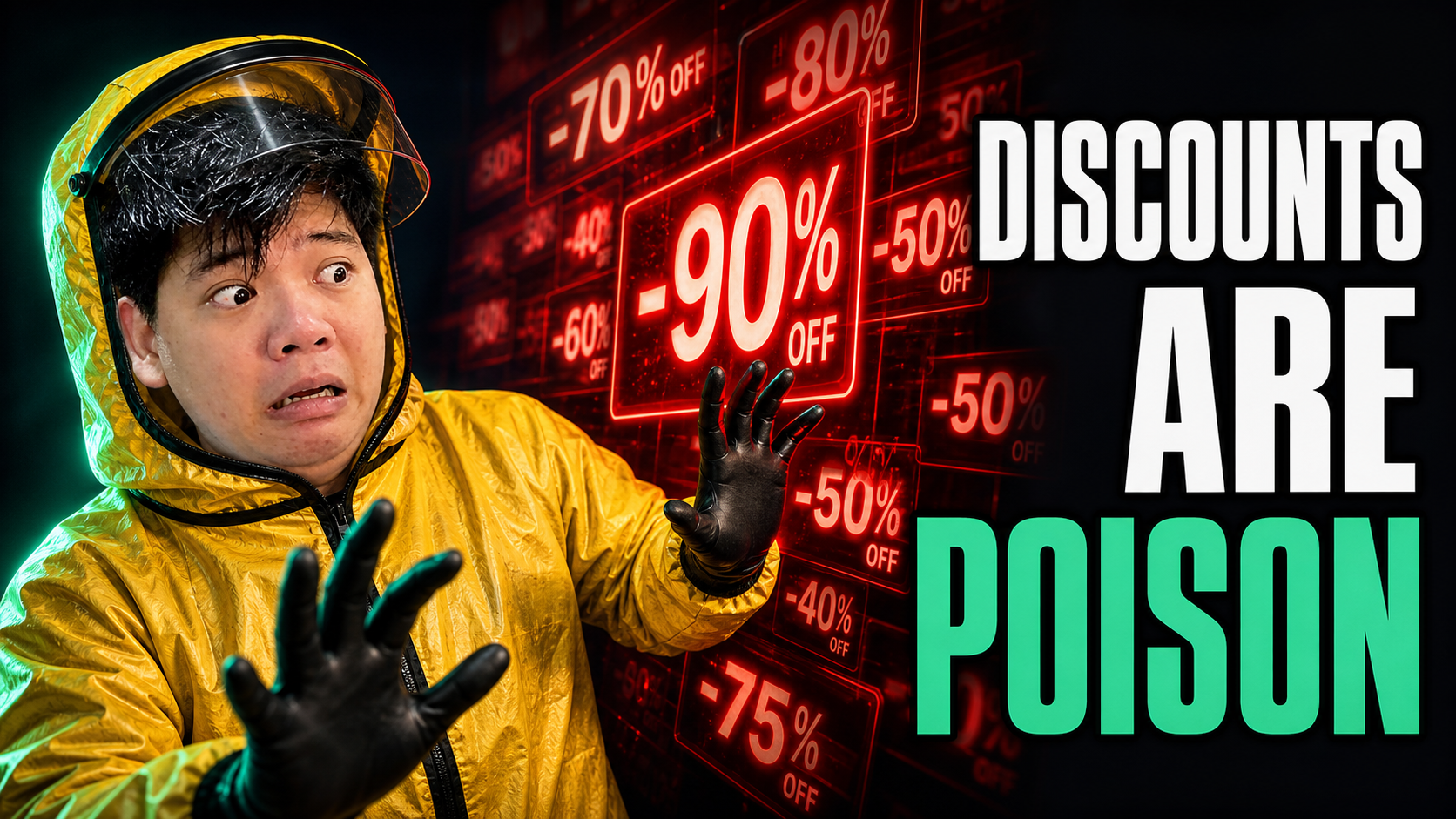
The first thing I noticed when I opened this account was the discount codes. Every promo for the last eight months was a straight percentage off. 15% here, 20% there, the occasional 25% when a month was running soft.
The margins told the rest of the story. Every one of those promos had carved a chunk straight out of contribution, and the brand had quietly trained its customers to wait for the next code before buying.
There was a better tool sitting right there unused. A gift with purchase. And used properly, it does something a discount code can never do.
Why a free gift beats a discount on the maths alone
This is the part most founders haven't actually run the numbers on, so let me put it plainly.
Say you sell a hero product at A$120, and your landed cost on it is roughly A$40. You want to push average order value, so you're weighing two offers.
Option one: A$20 off. Simple, and the customer feels it. But that A$20 comes straight off your margin, every single order, no exceptions.
Option two: a free gift that retails at A$40 but costs you about A$6 to make. To the customer, that reads as a A$40 saving, far stronger than A$20 off. To you, it costs A$6, not A$20.
Same perceived generosity, a third of the cost. That's the whole game. A gift lets you look more generous to the customer while protecting more of your margin than a discount ever could.
And there's a second, quieter benefit. A discount is forgotten the moment the order ships. A physical gift sits in their kitchen, or on their head, reminding them of you. One is a number they stop thinking about. The other is a small, ongoing piece of brand.
Where a gift earns its keep on subscription
Here's where it gets genuinely interesting, and where I'd push you hardest if you sell anything consumable.
A well-chosen gift moves your first-order subscription rate in a way a dollar-off code rarely does. We've seen brands take a piece of branded merch that costs a few dollars, reserve it for subscribers only, and watch their subscribe-at-checkout rate climb hard.
To put that into perspective: I've seen a consumables brand go from a third of new customers subscribing to well over half, largely off the back of a gift you could only get if you subscribed. A "you can't have the hat unless you subscribe" mechanic. The gift cost them almost nothing per order. The lift in recurring revenue was the kind of number that changes a forecast.
That's the case for gifts over discounts in a sentence: a discount buys you one order, a gift can buy you a subscriber.
The rules we actually give clients
So gifts beat discounts. That's the easy part. The hard part is picking the right gift, because a lazy one will flop and a wrong one will cost you money. Here are the rules we hand clients.
Rule one: pick gifts by the spread, not the sticker
The gift you want is one with a big gap between perceived value and what it costs you to make. High MSRP, low cost of goods. That's the spread.
A A$6 item that reads as a A$40 value is a brilliant gift. A A$25 item that reads as a A$30 value is a bad one, because you're spending real money for almost no perceived lift. Run every potential gift through that lens first: what does the customer think it's worth, and what does it actually cost me? The wider that gap, the better the gift.
Rule two: never, ever gift your hero product
This is the one I'll plant a flag on. Do not give away the product that most of your customers buy first.
Two reasons. First, you'll cannibalise. If your best-selling item suddenly comes free with something else, you'll lose the orders that would've bought it outright, and your blended margin drops. Second, and this is the bigger one, it's just strange to tell thousands of people who paid full price for your hero that it's now free with the right order. That stings the customers who matter most to you.
I've watched founders talk themselves into "free hero product with this bundle" because the maths looked profitable on a spreadsheet. Don't. The damage is hard to see on a chart and very real in the inbox. Pick a strong, popular item that is not the thing people came for.
Rule three: use a mystery gift to add a bit of theatre
A mystery gift is a lovely mechanic when it fits. Instead of "free item", it's "free mystery item", and the customer might get the standard version or, occasionally, a much nicer one.
It works because it's a game. People enjoy the small gamble, and it suits brands that already have a playful streak. One thing to watch: it only works when every possible outcome is something the customer genuinely wants. "Mystery gift" is delightful when any version is a win. It falls flat the moment someone could open it and feel they got the dud. So keep the prize pool tight and all upside.
Rule four: a mystery or tiered gift is how you move overstock
Here's a use for the mystery mechanic that goes straight to your unit economics. Build the gift pool partly out of the stock you're over-invested in.
You've got slow movers sitting in the warehouse tying up cash. Fold a few of them into a mystery gift, alongside some genuinely desirable items, and you've turned dead inventory into a compelling offer. The customer gets a fun surprise, you clear stock you needed gone, and you didn't have to run a fire-sale discount to do it. Two problems solved with one mechanic.
Tiered gifts do similar work. A better gift kicks in at a higher order value: a small item over A$80, a more impressive one over A$150. It nudges average order value up while letting you place the more expensive gifts only where the basket can carry them.
Rule five: gifts are a scalpel, discounts are a hammer
I'm not telling you to never discount. There's a time for it, usually clearing winback customers who've gone cold, where a straight dollar-off is the cleanest tool.
But for everyday promo, a gift should be your default and a discount the last resort. The reason is the one we started with. A gift protects margin, builds brand, and lifts subscription. A discount does none of those and trains people to wait. If you find yourself reaching for a percentage off every month, that's usually a sign your offer thinking has gone lazy.
A quick gut-check before you launch one
Before you run any gift with purchase, I'd run it past four questions:
- Is the spread wide? High perceived value, low cost to me.
- Is it something people actually want? A bad gift is worse than no gift.
- Is it definitely not my hero product?
- Does it help me somewhere else, like clearing overstock or lifting subscription?
If you can answer yes to those, you've probably got a gift that grows the business instead of quietly bleeding it.
This, by the way, is exactly the kind of thing we sit down and map out with clients, because the right gift is never the obvious one and the wrong one is expensive. If you've been defaulting to discount codes, try modelling one gift offer against your usual percentage off. Put the perceived value, the real cost, and the likely effect on subscription side by side. I think the gap will surprise you, and I'd genuinely love to hear what you find when you run it.


Recent Insights®



.webp)

Powered by © Pigeon Digital 2026. All rights reserved.
We acknowledge the Traditional Owners of the land on which we work, the Wurundjeri Woi Wurrung Cultural Heritage Aboriginal Corporation people of the Kulin Nation, and pay our respects to Elders past and present. We recognise their continuing connection to Country, culture and community.
.svg)