The Post-Purchase Upsell Most Brands Get Wrong (and the 'Egregious Offer' That Lifts AOV $20+)

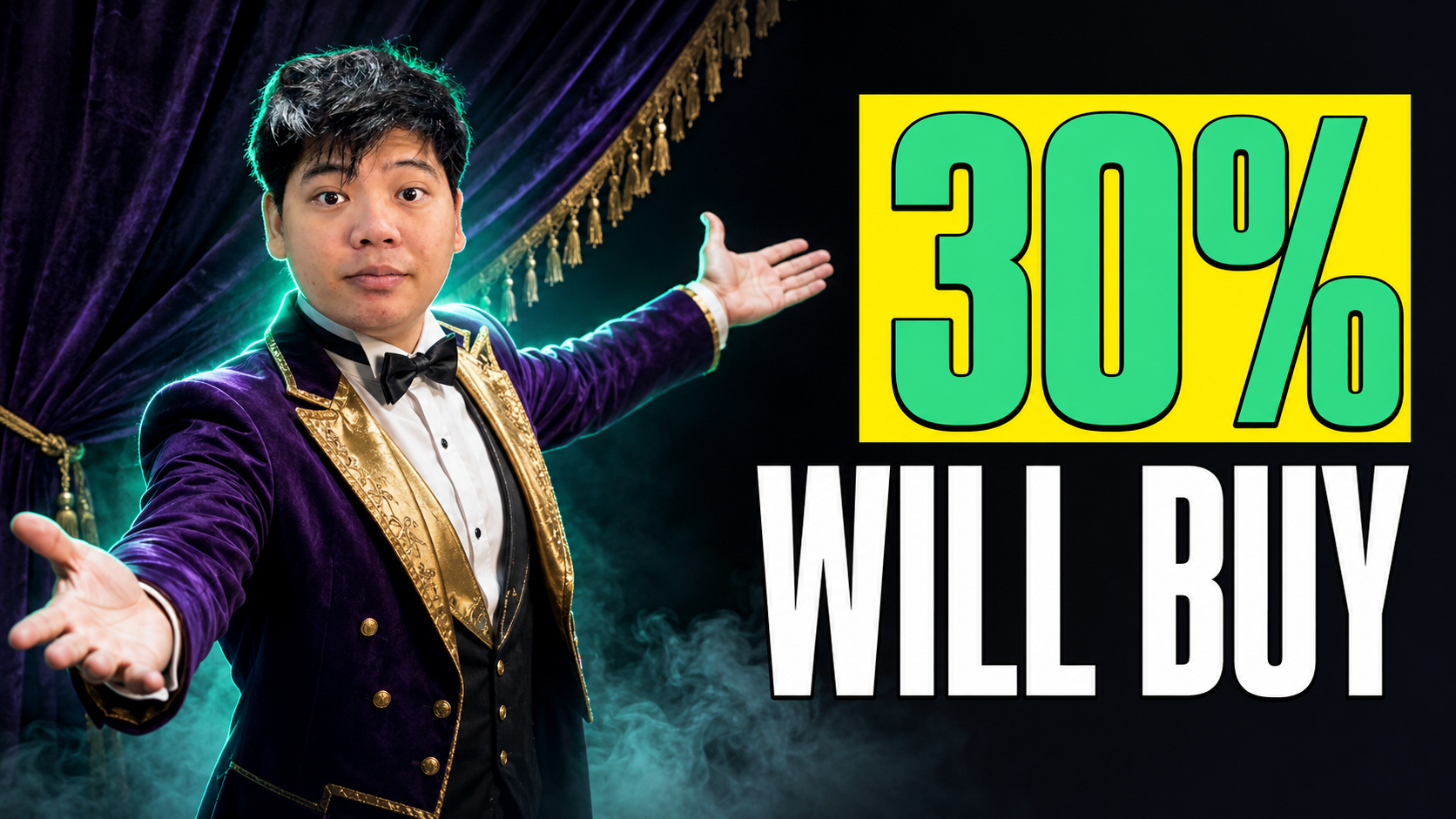
Thirty percent. That's the share of buyers who'll add a second order to a purchase they've already completed, if the offer in front of them is good enough. Not 3 percent. Thirty. On a screen they see for about four seconds, after the money's already left their account.
That number gets ignored, and it's one of the cheapest sources of profit a brand has. So let me unpack what the offer actually is, the maths that makes it work, and the one ordering mistake that quietly kills the whole thing.
The offer that earns the take rate
First, what we're talking about. The post-purchase upsell is the screen that appears immediately after checkout, before the thank-you page. The customer has already paid. This is a one-click add to that same order, no re-entering card details, no friction.
Most brands waste it. They show a vaguely related product at full price, get a take rate somewhere near nothing, and conclude the whole mechanic doesn't work for them.
Here's my take: the upsell that actually moves AOV is almost embarrassing in how aggressive it is. You offer more of the exact thing they just bought, at a discount steep enough to feel slightly unreasonable. Not 10 percent off. Half off. Sometimes more.
Say someone buys two or three pairs of socks. The post-purchase offer is ten pairs at 50 percent off. Someone buys a single jar of a skincare product they'll get through in two months, you offer three jars at a price that makes stocking up a no-brainer. The instinct most founders have is the opposite: "they just bought, they're done, leave them alone." But a buyer who's already decided they like you, with their guard down and the purchase still warm, is the easiest person in the world to sell to. They've cleared every objection that normally stops a sale. The only question left is whether the deal is good enough to bother, and an egregious one answers that.
The maths, done honestly
Let me walk the numbers, because the headline take rate hides how the average actually moves.
Picture a base AOV around $60. You bolt on a post-purchase offer: a big bundle of what they just bought, discounted hard, that lands at roughly $170 if taken.
Not everyone takes it. Most don't. But say 30 percent do. Across a hundred orders, seventy stay at $60 and thirty jump to $170. Run that and your blended average order value lifts by something like $33 an order. Even halve the take rate to a more conservative 15 percent and you're still adding north of $15 to every order in the cohort, on a screen that cost you nothing to build.
That's the bit people miss. You don't need most buyers to say yes. The increase per acceptance is so large that even a modest take rate drags the whole average up. A lift of $20-plus an order is very achievable here, and that's $20 of pure top-line you can then feed straight back into what you're willing to pay to acquire the customer in the first place.
And to be clear, these are illustrative numbers to show the shape of it, not a promise. Your take rate moves with your category, your price points, and how genuinely good the offer is. But the mechanism is sound, and it's about as close to free money as ecommerce gets.
The ordering mistake that kills it
Now the contrarian bit, and it's the part I'll plant my flag on.
A lot of brands fill that post-purchase real estate with a survey. "How did you hear about us?" The attribution question. It's understandable, that data is genuinely useful for working out what's actually driving sales, so the instinct is to grab it the second you've got the customer's attention.
My take: the survey should never come before the offer. Never.
That post-purchase moment is the single highest-intent slice of attention you will ever get from a buyer, and it's measured in seconds. Spend it asking them to do you a favour and you've burned it. Sell to them first. Get the offer in front of them, let them take it or leave it, and only then ask where they heard about you, on the next screen, once there's nothing left to sell.
I see the order reversed constantly, and it's a quietly expensive habit. You need them to fill out your survey, sure, but you need them to buy more from you first. The money question comes before the marketing question. If you've put a "how did you find us" dropdown ahead of your upsell, you've prioritised a data point over revenue, and you're paying for that choice on every single order.
The care upsell that's almost pure profit
There's a second upsell worth stacking, and it behaves differently to the bundle. The warranty, or what I'd call the "care" offer.
You've seen the version the big players run. Buy the laptop, get offered the protection plan for a few hundred dollars. The buyer rarely uses it, often forgets they even have it, and pays anyway. That's not an accident. It's one of the highest-margin add-ons in retail, because most of what you're selling is peace of mind.
You can build your own. Price it at roughly 10 to 20 percent of your AOV, give it a plain name, "[Your brand] Care" or similar, and make the promise simple: anyone who bought this and added the cover gets a replacement, no charge, no argument, if something goes wrong. On a $100 order that's maybe a $12 to $15 add-on. Even a modest slice of buyers taking it drops almost entirely to your bottom line, because your actual cost is only the replacements you occasionally ship, which is a fraction of what you collect.
It won't move your average the way the bundle does, the dollar figure's smaller. But it's some of the cleanest margin in the whole business, and it stacks neatly on top. A buyer can take the big discounted bundle and add the care cover. Two upsells, two completely different jobs, both firing in the same warm post-purchase window.
Why this sits above almost everything else
Step back and look at what makes this so attractive relative to the other ways you could lift profit.
Most growth levers cost you something upfront. Better creative takes a team and a production budget. Channel expansion takes new people and new measurement. Even a website redesign is weeks of work and risk. The post-purchase upsell costs you an afternoon to set up and then runs on its own, on traffic you've already paid to acquire, on a sale that's already closed.
It's the rare lift that doesn't touch your ad spend at all. Every extra dollar of AOV it produces is a dollar you didn't have to buy. And when your average order value goes up, the maths on customer acquisition gets easier across the entire account, because you can now afford to pay more to win each customer than the brand sitting next to you with the lower average. The upsell quietly raises the ceiling on everything upstream of it.
Which is why I find it genuinely strange how often it's left as an afterthought, a half-built screen with a survey on it, when it's arguably the highest-return hour of work available to most brands.
So here's the question I'd sit with if I were you. If you walked through your own checkout right now, as a customer, what would you actually see on that final screen, the moment your money's gone and your guard is down? An offer good enough to be slightly hard to refuse? Or a form asking you to do the brand a favour? Whatever's sitting there is running on every order you take, and most founders genuinely don't know which one it is.


Recent Insights®

.webp)

Powered by © Pigeon Digital 2026. All rights reserved.
We acknowledge the Traditional Owners of the land on which we work, the Wurundjeri Woi Wurrung Cultural Heritage Aboriginal Corporation people of the Kulin Nation, and pay our respects to Elders past and present. We recognise their continuing connection to Country, culture and community.
.svg)