Hit a Scaling Wall? The Only Three Levers That Get You Out

Nine times out of ten, when an account hits a wall and the founder comes to me panicking, they've already reached for the same lever. They've started cutting spend.
The cost per acquisition crept up, performance dipped, so they pulled the budget back to protect the number. Felt responsible. It's actually the one move that makes a plateau worse.
Because when you descale a Meta account, you don't gently step down to a safer level. You walk down a staircase you can't easily climb back up. Cut spend 20%, the algorithm has less to work with, performance softens a touch more, so you cut again, and again, and the whole thing spirals down to almost nothing. I've watched accounts talk themselves from a real budget down to a rounding error this way, one "responsible" cut at a time. Getting spend back to where it was after that is genuinely hard.
So the first thing I tell people who've hit the wall is: hold the spend. Unless you're bleeding serious money every day, don't descale. Park the budget where it is, even at break-even, and go fix the actual bottleneck. The way out of a plateau is never cutting. It's finding which lever is jammed.
And there are only a handful of levers that matter. Here's the teardown.
First, rule out the lever everyone reaches for
The default reflex when an account stalls is to make more ads. More hooks, more angles, another batch from the editor. Sometimes that's right. But creative is the one people over-index on because it feels like progress, and most of the time the wall isn't there.
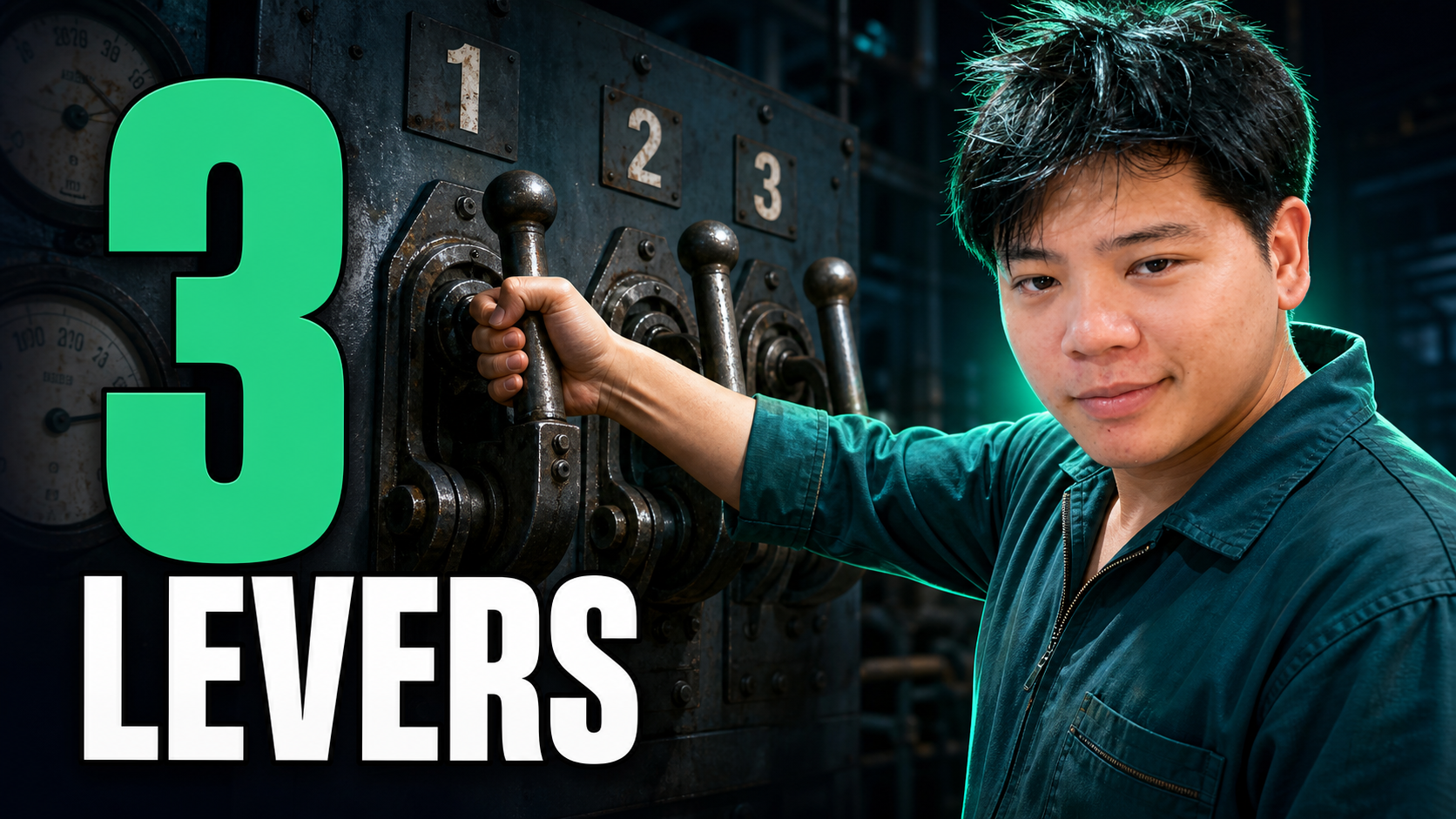
So I treat creative as the first checkpoint, the box you tick and move past. Once you've honestly ruled it out, there are only three levers left that actually get a capped account moving again: the landing page conversion rate, the average order value, and the lifetime value. Same plateau, three very different fixes. Pull the wrong one and you burn a month making ads when your problem was a checkout page.
Work through the checkpoint first, then the three, in that order, and find the one that's actually jammed.
The checkpoint: creative and CPA
This is the lever everyone reaches for, so let's be precise about when it's the real problem.
Creative is your bottleneck when the ads themselves have stopped doing the work. The hook is tired, the angle is appealing to too narrow a slice of the market, or the desire you're tapping just isn't urgent enough to make people act. Symptoms: click-through softening, cost per acquisition climbing on the same audiences, fatigue setting in faster each time.
If that's what you're seeing, new creative genuinely is the move, but new in the right way. Not the same winning video with three fresh visual hooks bolted on for the next three months. That's not testing, that's hiding. Take real swings: different desires, different awareness levels, different angles into the market. One brand I think about had quietly tested nothing but visual-hook variants of a single winner for a quarter, then found a completely different angle and dropped their cost per acquisition by roughly a third almost overnight. The lever was creative. They'd just been pulling it timidly.
But if your click-through is fine and your cost per acquisition is steady, creative isn't your wall. Stop making ads and look further down the funnel.
Lever one: landing page conversion rate
This is the lever people skip entirely, and it's often the cheapest one to move.
You're paying full freight to get someone to the site. If the page then loses them, you're not buying customers, you're buying bounces. A lot of brands run cold traffic straight to a product page and never test anything else.
The fix is rarely the ad. It's testing a different page type for cold traffic: an advertorial, a listicle, a proper landing page built to warm someone up rather than a bare product page expecting them to already be sold. The maths here is quietly brutal in your favour. Nudge conversion from 2% to 2.4% and you've effectively cut your cost per acquisition by a fifth without touching a single ad or spending a dollar more. Same traffic, same spend, more customers out the other end.
I'd test this before almost anything else, because it's fast, it's cheap, and the payoff on a small percentage move is enormous.
Lever two: average order value, and why a $12 bump beats another batch
Here's the lever I'd reach for when you can't get your cost per acquisition down no matter what you try, and it's the one I want to do the maths on properly, because it's the most underrated of the three.
Say you're acquiring customers at a $40 cost per acquisition on a $55 average order value. Your CPA is stuck there. You've tried new creative, you've tried the pages, it won't budge. The plateau is real because at that ratio there isn't enough margin to spend harder.
Now lift the average order value by ~$12, to ~$67, with a sharper bundle, a cross-sell at the cart, a "frequently bought together" that actually fits. The cost per acquisition didn't move. But that ~$12 is almost pure contribution margin, because you've already paid to acquire the customer, the order's already happening, and there's no extra ad cost attached to it. Every dollar of that bump drops much closer to the bottom line than a dollar of new revenue from a new customer does.
Compare that to another creative batch. The batch costs you production money and a few weeks, and it might shave your CPA from $40 to $36 if it lands at all, which is a coin flip. The AOV bump is a one-time bit of merchandising work that holds for every order from here on, and it directly widens the gap between what a customer's worth and what they cost. That's the gap that decides whether you can scale.
This is why I keep saying margin first. A wider margin is what lets you accept a higher cost per acquisition and keep spending, which is the whole point of scaling. You're not chasing a cheaper customer. You're making each customer worth more, so the customer you've already got pays for the next one.
Lever three: lifetime value, the slow one that changes everything
The last lever is the one that takes longest and matters most.
Sometimes you genuinely can't get the cost per acquisition lower, can't lift the order value much, and the page is already converting. The plateau is real and the front end is maxed. In that case the way out is the back end: get more customers to buy again, and the economics of the whole account change.
Think it through. If a customer's worth one order, your CPA has to sit well under that single order's margin or you don't have a business. If that same customer reliably comes back for a second and third order, you can afford to pay a lot more to acquire them, because you're not buying one purchase, you're buying a relationship. A higher acceptable cost per acquisition means you can outbid every competitor still optimising for the single sale, and suddenly the spend that wouldn't scale, scales.
This is the lever I'd protect above all the others. Acquisition is a hard, expensive game that gets harder every year. Retention is where the durable margin lives, and the brands that win are almost never the ones best at buying customers. They're the ones best at keeping them. It's slow work and it doesn't fix this month, but it's the lever that turns a capped account into one that compounds.
Where to from here
So the next time an account walls up, resist the cut. Descaling feels safe and it's the trap. Hold the spend, rule out the creative checkpoint first, then run the three levers that actually get you out: the landing page conversion, the average order value, and the lifetime value. One of them is jammed, and it's usually not the one you reached for first.
That's the exact diagnostic we walk through with clients before anyone touches a budget, and there's nothing stopping you running it on your own account this week. Pull your numbers, work the checkpoint and the three levers honestly, and the bottleneck tends to make itself obvious. If you do it and you're surprised by which one it landed on, I'd genuinely like to hear about it.


Recent Insights®



.webp)

Powered by © Pigeon Digital 2026. All rights reserved.
We acknowledge the Traditional Owners of the land on which we work, the Wurundjeri Woi Wurrung Cultural Heritage Aboriginal Corporation people of the Kulin Nation, and pay our respects to Elders past and present. We recognise their continuing connection to Country, culture and community.
.svg)