The Most Underrated Asset in Paid Social Is a Great Script

Walk through a hundred ads in almost any account and I'd guess fewer than ten started life as a written script. The rest are footage in search of a point: a folder of clips stitched together, a creator handed a product and a vague brief, a trending format copied because it was trending.
That ratio is the whole problem with most paid social creative, and almost nobody is talking about it.
We pour money into editors, into UGC creators, into AI tools that promise forty variations before lunch. We obsess over the first three seconds. And underneath all of it, the one thing that actually decides whether an ad sells, the script, the argument, the order you reveal things in, gets skipped. People will pay a creator a small fortune and spend hours in the timeline, then never spend twenty minutes writing down what the ad is supposed to say.
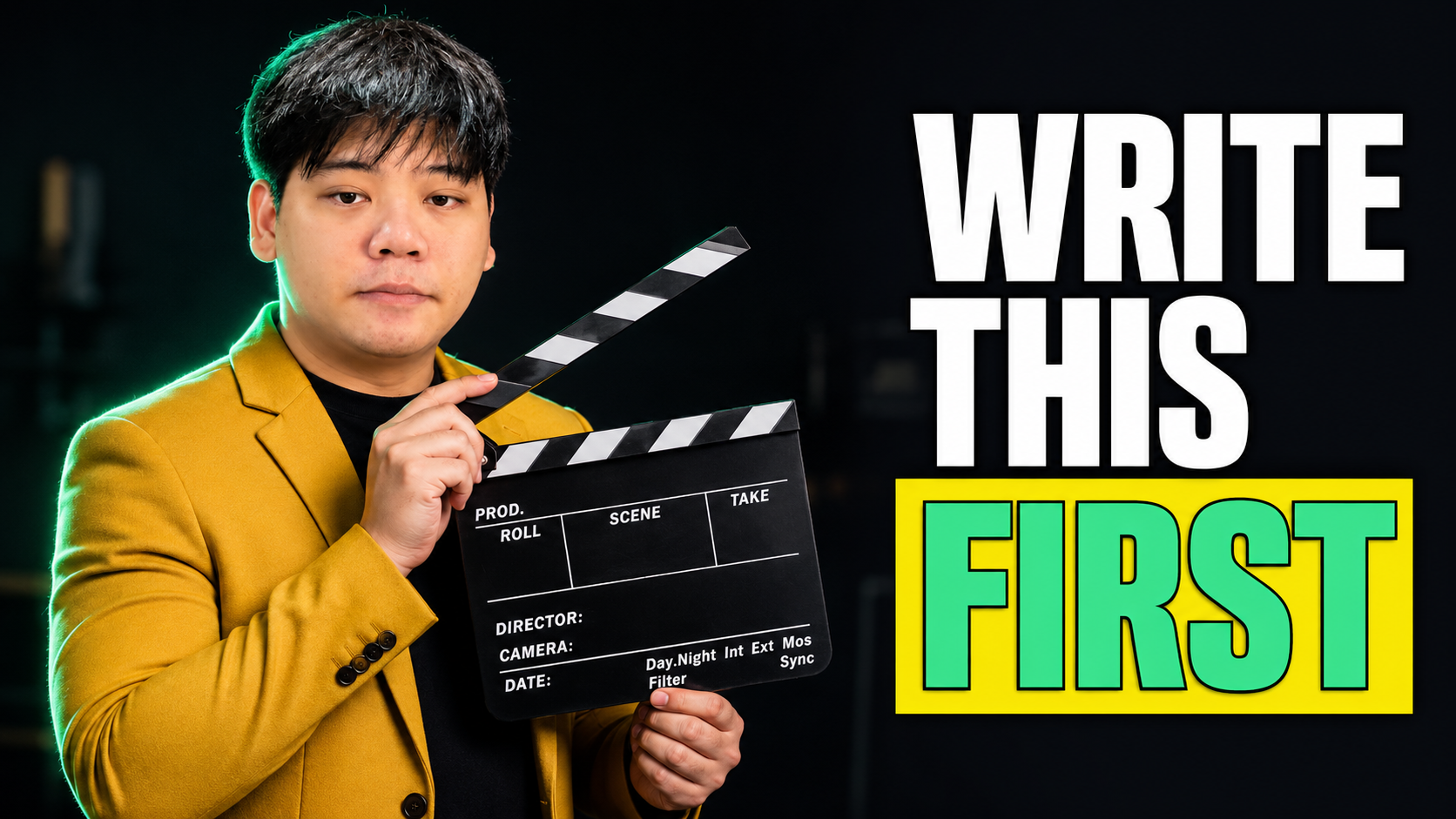
I think that's backwards. A great script can carry a mediocre edit. A brilliant edit can't save a script that has nothing to say. So let me give you the actual process we use to write one, from research to angle to structure, and a before-and-after that shows what changes when you do.
Why the script matters more now, not less
Here's the thing that's shifted. For a while, you could win on format alone. Be the first brand to do the street-interview style, or the green-screen reaction, or whatever the new shape was, and you'd get a result almost regardless of what you said. The format itself was the novelty.
That window has basically closed. When a format is fresh, using it is like throwing a rock into a small pond: a big, obvious splash. But once everyone's using it, you're throwing the same rock into an ocean. Nobody notices. The format stops doing the work, and you're left with the thing underneath it: did you actually say something worth hearing?
That's why the script is where the gains have moved. When you can't cut through on format, you cut through on substance. Can you say something specific and a little bit unique about your product, to a specific person, in an order that builds belief? That's a writing job. It's not an editing job and it's not a casting job, and it's the part most brands are quietly neglecting while they fuss over the parts they can see.
So a script isn't the captions you write after the footage comes back. It's the plan you make before anyone films anything. It decides who you're talking to, what you're going to claim, and the sequence in which you'll earn the click. Get that right and the edit becomes assembly. Get it wrong and no amount of polish rescues it.
Step one: research until you can quote the customer
Every good script starts in research, and not the skim-the-product-page kind. The job here is to come out the other side able to write in your customer's own words, about the thing they actually care about.
So I go where they talk unguarded. Reviews, especially the three-star ones, because they tell you what nearly put people off and what won them over anyway. Reddit threads and Facebook groups where the category gets discussed without a brand in the room. The comments under competitor ads, which are a goldmine of objections and desires stated plainly. Support tickets and the questions your team gets asked over and over.
What I'm hunting for is the exact language. Not "improves sleep quality" but "I stopped waking up at 3am". Not "ergonomic design" but "my wrist doesn't ache by the end of the day". When a customer's own phrase shows up three times across three sources, that's not a nice-to-have line, that's the spine of a script. You couldn't have invented it as cleanly as they said it.
The output of this step isn't a script yet. It's a short pile of real desires, real objections, and real phrases. If you can't quote your customer back to themselves by the end of research, you haven't done enough of it, and everything downstream gets weaker.
Step two: pick one angle, not five
This is where most briefs fall apart. People take all that research and try to cram every benefit into one ad. Lighter, faster, cheaper, kinder to your skin, loved by thousands. An ad that's about everything is about nothing. It gives the viewer no single reason to care.
An angle is the opposite of that. It's the one specific argument this ad is going to make, to one specific person. Same product, different angle, completely different ad. A magnesium supplement aimed at the person who can't switch their brain off at night is a different script from the same supplement aimed at someone with sore legs after training. Both are true. They are not the same ad, and trying to make them the same ad ruins both.
The way I lock an angle is to answer four questions before writing a line:
- Who exactly is this for? Not "people into fitness". A 40-something woman who's noticed her sleep getting worse and is quietly bothered by it.
- What do they actually want? The outcome they're chasing, in their words, from your research pile.
- What's stopping them from buying? The real objection. Tried things before, doesn't believe the claim, worried about a side effect.
- What's the one true thing about your product that resolves that? The single mechanism or proof that answers the objection.
Those four answers are your angle. Notice you've only chosen one desire and one objection, deliberately. The discipline is in what you leave out. A brand that can't say in a sentence what makes their product different, to one person, almost never wins on creative, because there's nothing for the script to be about.
Step three: structure the script so belief builds in order
Now you write, and structure is most of the battle. A script that says the right things in the wrong order still fails. I think about it in four moves.
The hook earns the next three seconds. It calls out the specific person from your angle and names their desire or their problem, fast. If the right person doesn't feel "this is about me" almost immediately, nothing after it matters. This is also a targeting decision, by the way: a sharp, specific hook tells the platform exactly who to keep showing the ad to.
The problem makes them feel understood. One or two lines, ideally in the customer's own words from your research, that show you actually get the frustration. This is where the three-star-review language earns its keep. People buy from brands that seem to understand them, and this is the moment you prove you do.
The mechanism makes the promise believable. This is the part weak ads skip entirely. Don't just claim the outcome, show why it happens. The ingredient, the design choice, the process, the proof. Without this the viewer files you under "every other ad making big claims" and scrolls on. With it, the desire becomes credible.
The close tells them exactly what to do and why now. The offer, the next step, a reason not to put it off. Clear, not clever.
That's the shape. Hook, problem, mechanism, close. It's not the only structure that works, but it forces the script to do the actual selling instead of relying on the edit to manufacture energy that the words never earned. Write it as a plan first, in plain language, then hand it to whoever's filming or editing. They're now assembling something that was already built to convert.
What changes when the script replaces the mashup
Let me make this concrete with an anonymised example. The numbers are invented to show the shape of the thing, not a guaranteed result.
A skincare brand we worked with had a hero ad that was, honestly, a mashup. Around fifteen short clips from various creators, cut fast to trending audio, the product flashing past a few times, a generic "you need this" energy over the top. It looked busy and modern. It was spending at a cost per purchase of roughly $61, and it had quietly plateaued. More edits in the same style didn't move it.
We didn't reshoot anything dramatic. We wrote a script.
Research said the real buyer was a woman in her 40s who'd noticed her skin changing and had already tried a couple of things that didn't do much. So the angle was narrow: that exact person, that exact frustration, the "I've been let down before" objection. The new script opened on a hook that named her situation plainly, spent a beat showing we understood the let-down, then spent real time on the mechanism, the specific reason this one worked when the last two didn't, before a simple close.
Same product, similar footage, a fraction re-shot to fit the new lines. The difference was that it now said one clear thing to one clear person, in an order that built belief. Over the following couple of weeks the cost per purchase settled to around $38, and just as telling, it held there as we scaled it rather than spiking. The mashup had been loud. The script was persuasive. Loud plateaus. Persuasive scales.
The footage barely changed. The thinking did. That gap is the whole point.
Where to from here
So here's the question I'd sit with, looking at your last ten ads. How many of them started as a written argument aimed at one specific person, and how many were footage in search of a point you never quite wrote down?
If it's mostly the second kind, you don't have a creative problem. You have a scripting one. And that's good news, because writing is the one part of this you can fix tonight, for free, before you spend another cent on production.


Recent Insights®


.webp)

Powered by © Pigeon Digital 2026. All rights reserved.
We acknowledge the Traditional Owners of the land on which we work, the Wurundjeri Woi Wurrung Cultural Heritage Aboriginal Corporation people of the Kulin Nation, and pay our respects to Elders past and present. We recognise their continuing connection to Country, culture and community.
.svg)